Justin Riddle
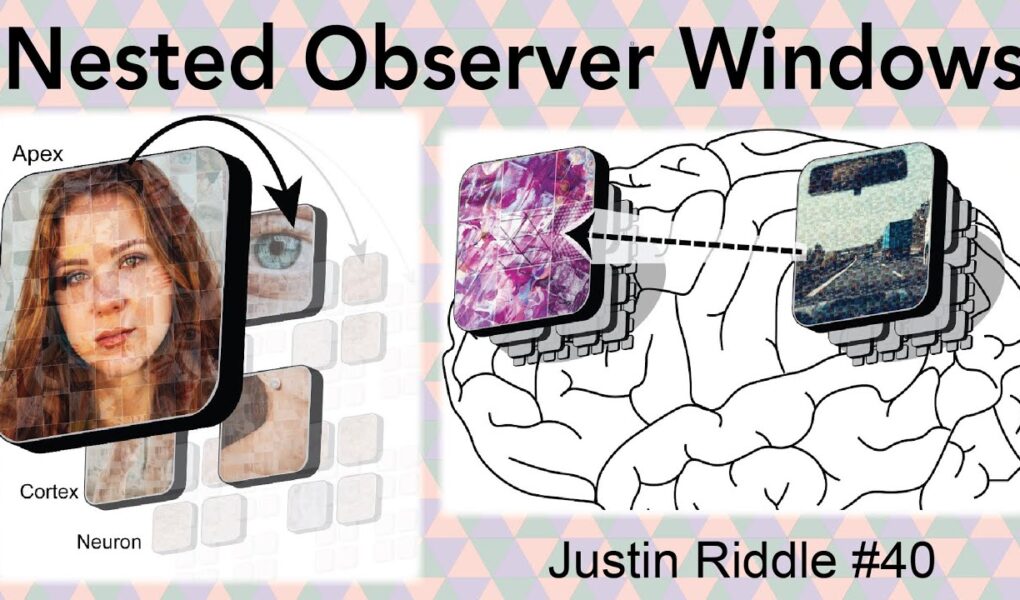
In episode 40 of the Justin Riddle Podcast, Justin provides an update of the Nested Observer Windows (NOW) Model. The paper describing this theory was recently published in the open-access Neuroscience of Consciousness journal (link below) and this video is an extended version of the Plenary talk that Justin gave at the Science of Consciousness conference in April of 2024 in Tucson, AZ (link below to conference recording). The NOW Model describes the mind as a nested hierarchical system in which there are many different cognitive systems within the brain at multiple scales. We are familiar with neuron-centric theories of consciousness, and yet why are we so fixated on the level of the neuron. There are synapses that comprise the neuron, there are microtubule systems within the neurons that appear to be electrically active, and there are neuronal population dynamics above the neuron which display prominent electrical properties. The cellular level is one level within a multi-scalar system. Evidence from cognitive neuroscience is suggesting that the low-frequency macroscopic electrical activity in the brain is closest correlated to cognition and brain stimulation techniques that drive these neural oscillations can reproducibly create changes in cognition. Therefore, it appears that these macroscopic scales are “causally” relevant to cognition. How then do all of these multiple levels connect to each other?
Observations from neuroscience show us that these multiple scales are electrically coupled to each other, a phenomenon called cross-frequency coupling. With coupling across these multiple scales, there is a mechanism for how information processed at different scales can be communicated up and down the nested hierarchy of the brain. The NOW Model essentially takes cross-frequency coupling very seriously. Your mind is at the apex, the top, of the brain hierarchical system and there are nested cognitive processing systems within you. A model by which there are nested cognitive systems explains a whole range of psychological phenomena that are not current explainable under single-level neuron theories of consciousness. For example, the fact that we are only aware of a high level of abstraction of our experience and yet can interact with a rich perceptual landscape and initiated complex motor movements can be explained by an interaction between ourself at the slow apex and the lower levels. Another explanation is how slow our cognition really is: the NOW Model suggests that we are operating in the time range of 1 cycle per second or even slower. Our thoughts are sluggish and filled with abstraction (perhaps a key to intelligence) but contain the richness of the faster systems. Beyond capturing a deeper range of every day experiences, the NOW Model also readily accounts for dissociative identity disorder and new psychotherapy techniques that conceptualize the self as a family (internal family systems). This is just the tip of the iceberg from changing our self-conceptualization from singular into a multiplicity of nested systems. There is a lot of work to be done in this space to validate the potential cognitive reality of the NOW Model!
~~~ Timestamps ~~~
0:00 Introduction
12:30 Overcoming reductionism
22:22 The closest correlate to cognition
31:40 Electrical coupling across scales
38:24 Mosaic tiles of experience
49:15 What is it like to be hierarchically conscious?
1:02:06 The NOW Model in exceptional systems
1:18:12 Consciousness in the brain and body
NOW Model paper (free to download): https://academic.oup.com/nc/article/2024/1/niae010/7631826
Plenary #6 Talks from The Science of Consciousness 2024
https://www.youtube.com/watch?v=Ng2G6wIzXPc
Previous episodes of relevance:
– Episode 16 on Slow Wave Electromagnetic Mind
https://youtu.be/d5J0N6JLSxM
– Episode 17 on Nested Hierarchical Consciousness
https://youtu.be/0q37UfNpCLs
Merch store: https://justinriddle.myspreadshop.com/
Website: www.justinriddlepodcast.com
Email: justinriddlepodcast@gmail.com
Music licensed from and created by Baylor Odabashian. BandCamp: @UnscrewablePooch
Painting behind me by Paul Seli. IG: @Paul.Seli.art
Source

Yes … but let us clarify that a bit. : ) First, we must consider math to be a subset of geometry and not the other way around.
Bro? WTF? Bro? Where is episode 41? I just watched your for the first time and I just learned I am some kind of quantum computer and other stuff…. Which is wicked! But? ? You are gone
Following my instinct got me here
Thanks Justin, I watched all your videos!
Can you also cover Mark Solms' "The Hidden Spring" approach to consciousness please?
Thank you for sharing your work with the world 💕 it’s a really special theory and it makes a lot of sense to me to put it into a bigger perspective of being observed by others in the universe and they might be observed by others in the future 💕 it’s really important to share your work with others in the future because it makes it easier to understand the universe in the future for us all ❤️ thank youuuu and have a good night
Wow! What's great channel!
I quote below what I wrote in a book 12 years ago, not to show you how good I am. I'm writing it so you can see how many years I have felt alone and mocked in my research on human consciousness. I love your videos and I appreciate your research.
"Activities such as eating or driving on a well-known road are particularly significant for understanding the functioning of the mind with respect to consciousness: that is, it seems that there can be a mind that acts independently of consciousness, or as it were at a lower level of consciousness, so much so that one can drive home without realizing it, absorbed in one's own thoughts or listening attentively to the news on the radio, but arriving safely.
There are plenty of interesting experimentable examples in Vedic culture and in esoteric schools such as Steiner's or Gurdjieff's, such as the experiment of the drawer that has been closed for years or that of the last morsel of food on the plate.
Finally, let us consider the phenomenon of deep sleep in which individual areas of the brain are active, but disconnected from each other: even in the absence of consciousness as we commonly understand it, there is conspicuous brain activity, but of each individual area on its own. This shows that cognitive activity is supportive of consciousness, but ultimately is not its complete essence and therefore cannot be its exclusive location. "
Sincerely some of the problems science open now, I closed 5 years ago. I am an AI computer scientist I would love to be your friend and share my work.
Waiting for the next video. I binge all of your videos in just a week. Man you motivated me to learn about quantum science.
I would like to see your video presentation on idea of 'songs of life and mind' that is now developing by Richard Watson. 🙂
how is this different from freud or jung's theory of mind ?
Bro How is everything not deterministic?
Interesting.
Awesome research!
Don’t forget the gut – the ‘second brain’
1:21:56 This was interesting, but I just can't tell why it has to be nested? What if my own attention, which is to say my conscious attention, is just another self amongst all the other selves. It's not nested I just have a different experience of it. It does not have undue control over other parts, although having free attention to apply by choice is a powerful capacity. Perhaps, in the absence of conscious attention, other parts can't really think about themselves, and make better choices.
1:12:11 people resisting dissociative disorder diagnoses. It may be a mistake to assume that we should be unitary beings, this can become an underlying assumption that is the takeaway from IFS. So It's really important to stop labeling the multiple personality quality as a problem. In a dissociative state I don't think the multiple selves is the problem, it's some kind of extreme state in one or more of those selves, as real as and identical to any extreme state any of us may suffer. Or at least that would be the thinking
24:31 This is a great discussion and I would be like to hear your thinking regarding internal family systems IFS and it's alignment with the work you're doing. I think there's some profound cross pollination that could happen there
Oh haha I've now gotten to the part where he starts talking about IFS
24:31 phase amplitude coupling
Isn't the information capacity of the lower frequency domain simply lower than that of the higher frequency domain? Does this conversation the possible impact of cross frequency coupling
24:31 rhythms of brains as integrative body experience. It awareness is flickering…
15:51 dismissing the reductionism that leads a neuroscientist to become a particle physicist… But it seems to me that there's no functional meaning to the word consciousness established yet so this is sort of a confused sequence. I like Joscha Bach's thinking on this, our Selves are simulations of our own minds, built in our brains to make sense of our bodies and our lived experience. Consciousness is second order cognition, it is the attention that we turn to watch ourselves be ourselves. We can modulate that attention with drugs or meditation in somewhat predictable ways. That is, I think we are closing in on a more rigorous understanding of what our Selves are. JB has brilliant insights on these points
12:29 hierarchy of consciousness. It seems to me like the ideas that I am the manager of numerous parts of myself simply don't give them enough power in this set of relationships. Think of alcoholics or other addicts who are driven to act in ways that seem very outside of their own control. The line between invisible behind-the-scenes help vs invisible misdirection might be thin. It feels more accurate to expect these numerous selves to be as self-like as I am, as this consciousness that I turn on them sometimes is.
I'm excited about how this idea of hierarchical consciousness addresses the multiplicity and the duplicity of our internal communities.
I think the hierarchical intelligent approach is pointing at the same functioning that internal family systems work and other parts work is pointing at. They may have some advantage because we are wired to think about people, not abstract intelligences. So if I am a multitude, if I've got lots of beings within myself, all spun up by myself to help me respond to the world, some of whom are getting out of hand and acting in disturbingly human kinds of ways… All those beings get their own subconscious in some sense, that is to say they're only conscious when I'm thinking about them, but they're plugging away all the time potentially. Or at least when they feel called to.
So that leaves me very curious I'm still at the beginning of the video, about whether the hierarchical part sounds important. In IFS there isn't exactly a hierarchy, there is a Self capital s that brings attention and calm creative connection… But the parts essentially work themselves out of their deprecated roles and into newly re-empowered and re-directed brings. I'm just thinking out loud as I begin this video because I'm curious about how these views overlap or contrast
When I can't think of a word or otherwise forget something I'm reaching for, I've developed the response of saying out loud "that's okay it'll come back to me". That helps me relax out of the convulsion of attention that can happen when I demand my intelligence work in some way it is incapable of at that moment. The thing almost always comes back to me, often in just a few seconds
I like the IFS model of multiple selves, and I think of my attention, which may be we can call my consciousness because that's where I'm conscious of myself, that little window of attention I move around, that all seems parallel to your point about the mind chugging away in the background