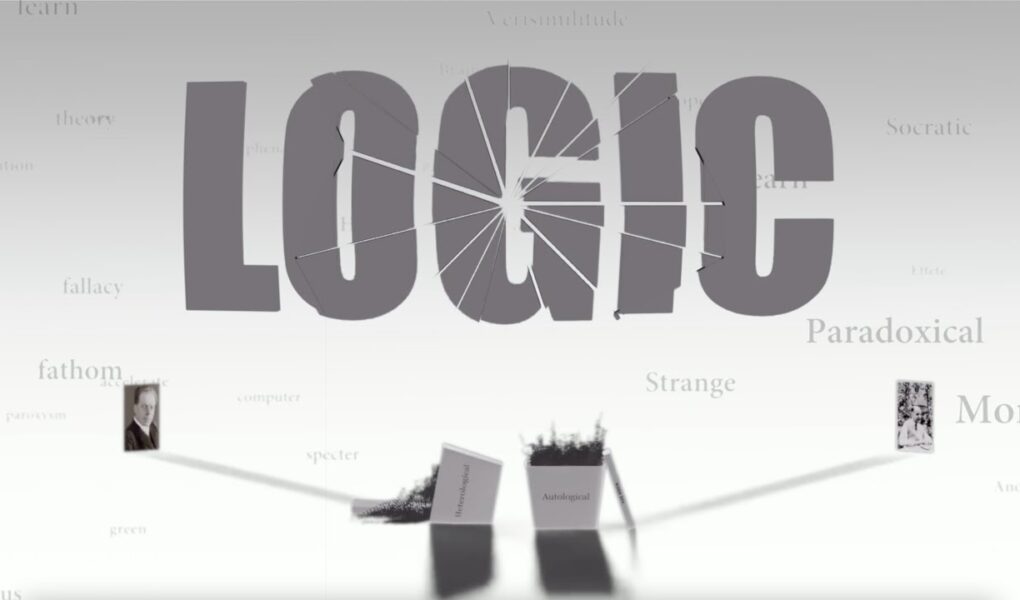
Dialect
Whoever said logic was infallible? Certainly not the German logicians who, in 1908, discovered this mind-bending paradox. Learn how they beat reason at its own game, all by asking a single question about two simple words. Don’t skimp out or you’ll miss the surprise twist at the end! Plus: a very brief, totally not copyright-infringing appearance by The Sorting Hat.
Enjoy the video and please consider helping support us on Patreon — https://www.patreon.com/dialect_philosophy
Contents:
00:00 – A Tale of Two Words
02:04 – Semantic Sorting
03:30 – Paradox in a Nutshell
04:41 – Grammatical Formulas
06:53 – Breaking Logic
10:12 – The Naive Objection
11:18 – This was never about words, was it?
As this video was nearing the end I truly got to wondering if Russell's Paradox and Godel's Incompleteness Theorem and Turing's Halting Problem were coming. Sure enough, all three (and logically they're pretty much the same thing). See, I've been studying this topic now for several years, but as an armchair study. And I've come up with this conclusion:
Never try to wrap your brain too tightly around a paradox.
But do try to understand Godel's Incompleteness Theorem. It takes some effort but it is understandable. Mathematics necessarily contains paradoxes; true mathematical statements can exist but it may be the case that there can exist no proof of their truth. In short, if a mathematical system is complete it is necessarily inconsistent, and likewise if it is consistent it is necessarily incomplete.
Oh, and, using broken logic to prove that logic is broken isn't logical. But broken (complete:necessarily inconsistent; consistent:necessarily incomplete) logic is the only kind we have. 😁
Computer generated narration?
Not for me
Superposition
Diabolical, I love it 😄
what if we say “autological” is heterological
The 2-part pattern in all these paradoxes is that they are 1) self referential, and 2) are negative (using the word "not"). These two notions appear to be incompatible together in our usual systems of logic.
This video makes me think of a numberphile video about -1/12.
Saying that heterological (the category) is heterological would mean attributing an adjective to an adjective, and thus, it would make the heterological attribute (or definition) of the set to be considered a heterological heterologic*, meaning that all the words found in the set are actually autological. And if we find heterologic (as a word) within the set, we find out that we cannot apply to it either an autological or heterological adjective (or category) because the word itself is a *definition of a word to which it is tied to. For example: polysilabic refers to polysilabic, while autological refers to self-refering. And you cannot say that self-reference is self-refering. (Or could you?) Another example is that heterological refers to non-self-refering. Then, heterological, since it refers to the attribute but not the word, is heterological. And maybe, in the same way, autological, since it refers to the concept, not the word, is heterological.
Maybe it is through the fact that we recognize the nature of these words as a kind of "living adjective" in the realm of words, that we see how they are useful when considering the context, but not to participate directly in the unfolding of ideas. I mean that the receiver should be aware that the speaker is describing an imaginary or a real car if both are fully aware of the conversation.
But we assumed that every word is either autological or heterological. This assumption doesn't have to be right. In fact it isn't right, because of the word heterological and autological themselves. Therefore you could put them in a third class for neither heterological nor autological words. Or not?
I just thought that the "not" from heterogical definiton and the word itself simply just cancle out. Like trying to -1 x -1 which is 1,
I thinking the grammar formula like math formula, it's kinda explained, not sure thought
All words are either autological or heterological except all words
❤. Dear, which software you use to make such interesting videis
Sorry if this is naive but isn't the real problem when you equate the set of all non-autological words = set of heterological words? I can see how you can make this assumption linguistically but not mathematically. Doesn't this video just demonstrate that the assumption that the set of all non-autological words = set of heterological words is a faulty assumption? In other words, it is our language which is defective, not our logic.
The key to this paradox is that we simply can not treat this world as static. We must add the time dimension. Also, we must acknowledge that information needs time to propagate, and the speed of the propagation of information is the speed of light. So, when you analyze a problem or a condition at time t0, you can not obtain its result or conclusion at the same t0 time, because of the speed of information. You will only get the result or conclusion at t1 time. Similarly when you analyze the problem or condition at t1 time, the result or conclusion will only emerge at t2 time. With this time dimension in mind, there is no paradox anymore, because every result at any given time t(n) is the consequence of the condition at a previous time t(n-1). The fallacy of the paradox is that it is trying to ascribe the result at time t(n) to the condition also at time t(n), which is nonsense since we know that information (i.e. causality) takes time to propagate at the speed of light.
I just disagree with the premise that a word can always be sorted into two boxes. double-entendres alone are a fairly immediate refutation. i might guess that putting words into "fractal boxes" might be possible.
Heterological is an Autological word. Autological is an Autological word. The statement "All words are either Autologocal or Heterological" is a true statement, not a paradox.?¿‽¿❓❔⁉️🚫
I don't see the paradox. I see confusion. We cannot reason formally in natural language.
07:58
but if the word 'heterological' is a word that does not describe itself
the definition part "a word that does not describe itself" actually describes 'heterological
so shouldn't it simply fall under the category of 'autological' words
i.e. Autological is autological
and Heterological is autological
4:10 It is not fully stated here why the word "autological" can't belong to these two categories, let me explain. The word "heterological" can't belong to either of these categories because it would create a contradiction no matter which category it belongs to, whereas the word "autological" does not create any contradiction no matter which category it belongs to, in other words, it belongs to both of these categories. If you think carefully, that's the problem. The categories "autological" and "heterological" are opposite categories by definition, so the word "autological" can't belong to both of these categories at the same time, which means it can't belong to either of these categories.
This is not a paradox. Like the barber “paradox” it is a fraud. Consider………… The Nelson-Grelling paradox is supposedly a simpler version of the Russell or barber paradox (though I do not agree that it is simpler though I do find it a superior analogy). It speaks of the two categories of words, one Autological (or homological) and the other, heterological. Autological describes words (is a collection of words) that describe themselves, e.g., English (in that the word is in fact English), or unhyphonated (in that the word “is” unhyphenated). Heterological describes words that do not describe themselves, e.g., big (which is not big), or hyphenated (which is not itself hyphenated). There is purported to be a paradox which arises in the attempt to categorize the word heterological (autological and heterological both being words and it is required by the law of excluded middle that each must be a member of one of the sets, autological or heterological). It is claimed that if the term heterological were autological, meaning that it described itself, (I suppose in its function as a set definition) then it must be heterological because the term is that which describes words that do “not” describe themselves. However, if heterological, meaning that it does not describe itself then it must be autological because again, by the law of the excluded middle, every word must be one or the other, i.e., autological or if not, heterological. The nature of the purported contradiction in all this seems clear, but is in fact a deception. The terms autological and heterological are not words referred to in their respective sets but rather the respective set definitions. The meaning of unhyphenated is apart or separate from the classification or set name, autological (autological because it is in fact, not hyphenated). This (autological) and heterological refer to or describe the nature of “other words”, their primary function or purpose which sets them apart, their unique quality which those words they classify do not have, i.e., the words to which they refer, refer only to themselves and not to others. In this paradox (that it might exist at all), they (autological and heterological) are required to do both. This is apples and oranges. They are not the same and do not perform the same in the structure of language or logic. These terms then cannot be classified with those which they represent or of which they are the set definitions. To claim that autological or heterological describes itself as such is tautological. Unlike the word unhyphonated which materially “is” unhyphonated, autological’s (or heterological’s) definition is arbitrarily assigned. There is no material aspect of the presentation of the term autological (or heterological) which is in agreement with the concept it presents. This is the same circumstance which exists in the barber paradox (see above) in which the barber, which in this case would be analogous to the set definition, heterological is “not” part of the set of men who shave themselves (analogous to the autological set of words) or those who do not and visit him to be shaved, (analogous to the heterological set of words), but of a third set of men (a third set of words) who shave others (terms that describe other terms rather than themselves). So, the terms autological and heterological cannot as set definitions, contain themselves. There is no paradox.
Thoughts?
Seems to me, the logical proposal was doomed from the beginning. That is you agree with the initial statement of the video, about the paradox of this logic sorting method, I believe blown seriously out of proportion.
Obviously, to me, the fact that the two words autological, and heterologcical themselves violate the initial premise. Making the exercise illogical upon engagement, and no wonder appears to "break" logic 🤔.
An exercise in counterlogic.
you can"t sort the sorters
The logical fallacy that this paradox commits is changing the definition of a word* midway through. This is also known as equivocation. When you shift the definition of a word* partway through an argument, the original premise (that being the word’s original definition) becomes untrue. This causes the premise to be considered “false” (though more accurately, it would be “untrue”) under classical logic. Due to the premise being untrue, you could create a valid argument for any conclusion you want, including contradictory ones. In other words, the reason that the contradiction/paradox comes about is because the rules of both language and logic are being misused, whether accidentally (inadvertently) or not
*this word being “heterological.” Side note: the words false and the concept of being untrue are also conflated within the paradox’s formulation. I believe that, at the start of the argument, the word untrue’s meaning was left unclear, leaving people free to assume it meant false. Later on, its meaning got implicitly changed to “anything that’s not fully true,” while the word false’s meaning was implied to be “the opposite of false” (as opposed to “the negation of false”)
I got that heterological is heterological and autological is autological. When we say a word describes itself, we mean that its definition or meaning applies to the symbolic representation of the word (the letters or grammar). Since any object is equivalent to itself, the symbolic representation "a-u-t-o-l-o-g-i-c-a-l" represents itself. By contrast, the symbol "h-e-t-e-r-o-l-o-g-i-c-a-l" is also equal to itself, therefore the meaning of heterological does NOT apply. So, It all comes together (in my mind at least) when you separate the meaning from the symbols we use to refer to the meanings. Kind of like how an address is not the same as the house. Or in computer programming terms, the memory address is not equal to the value it is referring to.