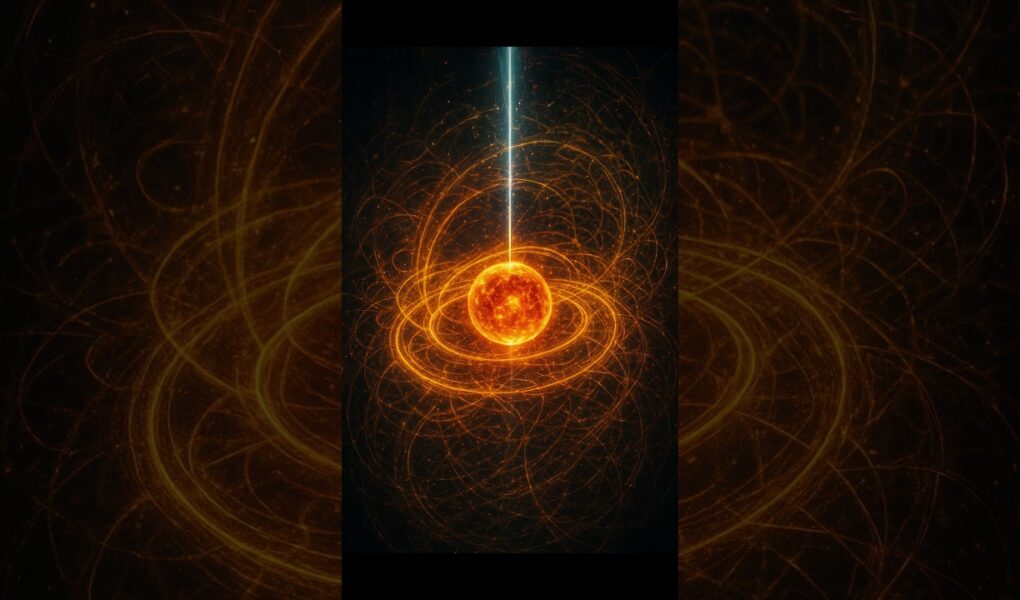
Motion Theory
https://www.youtube.com/@TheMotionTheory
Keywords: quantum Zeno effect, wavefunction collapse, quantum observation, motion theory, time perception, quantum feedback, temporal mechanics, loop resolution, quantum decay, altered time flow, feedback loops, quantum physics, rhythm of time, quantum measurements, reality observation, quantum system, state change prevention, measurement paradox, non-classical physics, frozen motion, observational interference, quantum mechanics paradox, delay in motion, collapsing wavefunction, quantum time, altered dynamics, temporal feedback, perception of change, motion freeze, entangled time, observer effect, physics podcast, theory of motion, subatomic observation, quantum stasis, Zeno paradox modern, temporal stalling, high-frequency observation, measurement interruption, science communication, physics explained, deep physics podcast, metaphysical physics, system dynamics, collapse interference, quantum stability, reality loop, time dilation, observation consequences, physics theory, temporal resolution, altered perception, modern physics insights, watch and stop paradox, state fixity, rhythm disruption, quantum behavior, entangled decay, science theory podcast, quantum temporality, physics and motion, temporal paradoxes, feedback and motion, quantum rhythm, system delay
Description:
In the world of quantum mechanics, reality behaves in ways that defy our classical intuition. One of the most mind-bending phenomena is the Quantum Zeno Effect—where constant observation of a quantum system prevents it from changing. In this brief but thought-provoking segment from Motion Theory, we explore the paradox of “Losing Time” by diving into how the act of observation can freeze motion and decay in the quantum world. Traditional physics explains this as the collapse of the wavefunction, halting transitions in the quantum state. But Motion Theory challenges this, suggesting that what’s truly at play is the interference of feedback—feedback that delays the resolution of motion itself.
When you observe a quantum system too frequently, you aren’t simply noting the passage of time—you’re altering it. You’re introducing interruptions in the system’s ability to evolve, to shift, to resolve into its next state. In other words, you’re not just seeing time—you’re affecting its rhythm.
This micro-podcast provokes a reimagining of time not as a flowing continuum but as something that “resolves”—unless the loop is disrupted by external feedback. It touches on the metaphysical implications of quantum theory and challenges the traditional view of time and observation. If you’ve ever wondered whether simply watching reality can change it, you’re not alone. The answers might surprise you.
Dive deeper into this emerging perspective on time and motion by watching the full Motion Theory podcast, where science, philosophy, and theoretical physics meet.
Source

Turn On CC
What Is Motion Theory?
Motion Theory is a new Theory of Everything that rewrites science from the ground up. It says everything in the universe is motion—structured, recursive, and synchronized. Not particles. Not forces. Not fields. Just motion, organizing itself.
🔹 Space? Not an empty stage. Not a vacuum.
Space is just structured motion without form—a tension field of unresolved loops.
It’s not where things are. It’s what everything is moving through—a dynamic medium of motion itself. What we call “distance” is just the difference in sync state between motion systems.
Space isn’t empty.
It’s the Motion.
🔹 Time? Not a dimension, but a measurement of Motion.
Time is just nested motion resolution—the rhythm by which one motion system compares itself to another.
Your heartbeat. A planet’s orbit. An atomic vibration.
Every system lives in its own time zone, defined by its sync rate—its rhythm of motion.
Time isn’t flowing.
Motion is resolving.
🔹 Energy? It’s not a “thing.”
Energy is just motion in tension—structured movement encountering resistance.
It’s how much effort a motion loop must exert to maintain its rhythm against disruption.
More tension? More energy.
Less resistance? Less energy.
No particles. No mystery.
Just the cost of preserving synchronization in a changing motion field.
🔹 Mass? It’s not an object’s “stuff.”
Mass is resistance to synchronization.
It’s how hard it is to change a motion loop’s rhythm.
Why does it “weigh” more?
Because its loop is denser, more entangled, harder to re-phase.
Mass = sync inertia.
Not a property of matter—
A byproduct of how deeply motion is locked in.
🔹 Forces? They’re not invisible pushes.
They’re structured motion gradients.
A “force” is what happens when one motion loop nudges another toward synchronization.
What we call gravity, magnetism, or electricity?
They’re just different patterns of motion resolving tension across space (the motion).
Force = motion imbalance seeking stability.
No particles needed.
No fields required.
Just motion. Always motion.
From this one principle—structured motion—everything emerges.
This theory explains:
✅ Why photons don’t travel
(We’re not catching particles—we’re detecting sync. Vision is rhythm alignment, not impact.)
✅ Why gravity isn’t a force
(It's the convergence of motion loops trying to synchronize into denser rhythm zones.)
✅ Why black holes trap motion
(The loops collapse into such tight sync that no motion can resolve outward.)
✅ Why life, thought, and biology exist
(They’re recursive motion loops that self-regulate, store rhythm, and resolve tension.)
✅ Why rituals, music, and emotions affect us
(They are motion sync events. Structured rhythm literally changes our internal loop dynamics.)
✅ Why the universe didn’t explode—it stabilized
(The Big Bang wasn’t a blast—it was a sync event. A motion resonance cascade that built all structure.)
Motion Theory doesn’t discard science—it decodes it.
It shows that behind every equation, experiment, and “law” is just one truth:
Everything is motion. Structured. Layered. Syncing.
And we’re just starting to see it.
—
There was never “nothing.”
There was never “before.”
There was only ever motion.
Not motion through time.
Not motion in space.
Motion as the origin. Motion as the canvas. Motion as the answer.
When we say “nothing” it's a linguistic failure—an attempt to describe an unstructured state from inside a structured brain. But unstructured motion isn’t nothing—it’s pre-synchronization. It’s chaos before the first loop. It’s static before the song.
The question isn't:
“What came before the Big Bang?”
It should be:
What allowed structure to emerge at all?
And the answer is:
Motion looped. Rhythm stabilized. A sync held. And from that—everything emerged.
Just the universe figuring out how to dance with itself.
You are Structured Motion inside Motion.
Enjoy it.
Build, Create, Experience, Explore.
It's Big.
Welcome to the Motion Renaissance. It was always Motion.
Motion theory book:
https://doi.org/10.5281/zenodo.15637756