Scott Manley
The New Vera C Rubin Obsservatory in Chile is a fast telescope designed to survey the night sky at great depth and revisiting the same locations every few days. That means it’s designed to collect data about the sky over space and TIME, this massive data set will grow 30 terabytes per day, and instead of requesting telescope time for scientific studies scientists will just be able to grab the data they need and apply computer power to analyze their problem.
It’s an absolutely revolutionary design in terms of its optics, camera, structure and processing power, and it will change our understanding of the universe.
Follow me on Twitter for more updates:
https://twitter.com/DJSnM
I have a discord server where I regularly turn up:
https://discord.gg/zStmKbM
If you really like what I do you can support me directly through Patreon
https://www.patreon.com/scottmanley
Source


Anyone wondering why we have another telescope can fk off lol.. make a bigger one
i love how the images are hdr
11:21 what is that website
The tones while searching the picture may actually be helpful.
If the program was super accurate, it may help astronomers find stuff they can't see?
So, how soon before someone puts out an app which sucks in the data from one image and not only does whatever you were using but provides info when you click on a galaxy/nebula/star cluster/star? It would probably have to limit the number of stars it can handle.
It will see those strange things moving through the solar system
It will see probes. Fxxking turn it on for fcxks sake
So good
You only need to know those who are that I’m gonna hit us
Why there is no any link in the description ?
As a result of the capability of this telescopes ability to determine an asteroids makeup and recent advances in propulsion supports a concept I have for making Mars more habitable. It involves the movement of ice asteroids to Mars but it also develops the technology to safely move asteroids to Earth orbit for easy mining. Can anybody recommend someone to help me move this concept forward?
This has the most articulate explanation of the complex lens, filters and mirror assembly I've seen so far. Thank you, Scott! 😁
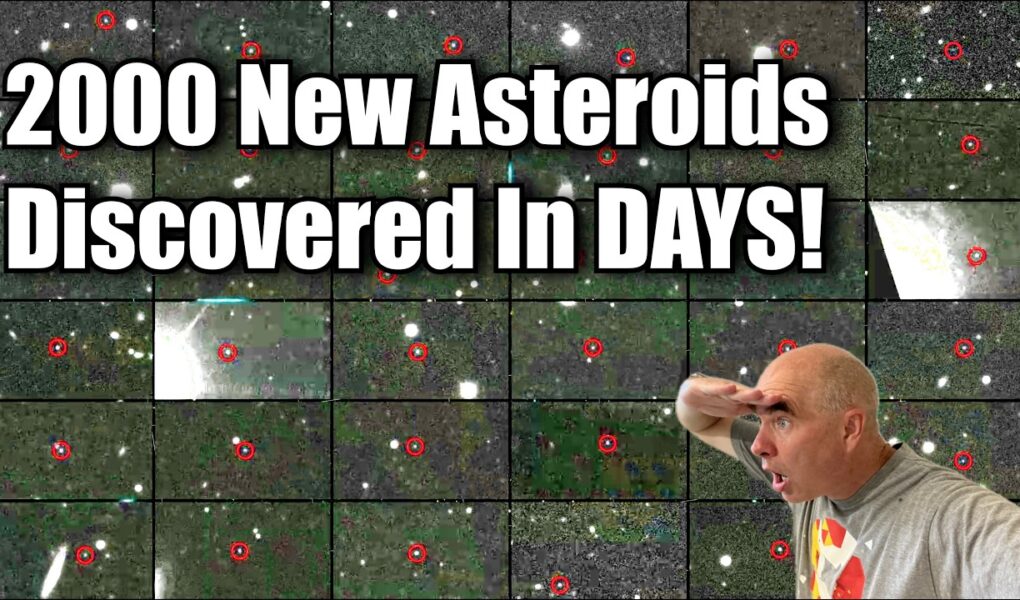
I still cannot get over the fact that two thousand new asteroids were discovered in the first 10 hours of operation, which is bonkers! 😁🤯 Thanks, Scott!
The secondary mirror on this telescope may be the largest convex mirror (3.4 metres) in use now, but the Extremely Large Telescope (ELT) will have a 4.2 metre secondary convex mirror.
18:49 Stupid DoD.
Those asshats should leave the nice science data alone.
Krypton?
Could the missing mass used to validate dark matter be astroid we don't know about
I'm curious as to why Einstein Rosenberg ri is are seami gly not visible in these images. However very evident in JWST.
11:30 how to access this page??
Planet 9 in the next 5 years.
Thanks Scott I discovered your rocket space channel. BTW I learned to flying at your home airport. I retired from United in 2018.
Turns out dark matter is just a bunch of asteroids
Will they be able to see the northern sky?
They should put the Vera Rubin Telescope in Space . In fact we need to build a Small Moon size Astronomy Space Station specifically staffed by Astronomers with Very Large Telescopes. ;-}
It's not "dark matter". It's called "Ether". When will you people start to learn? You behave like the inquisition. Very, very stupid!
Sorry for my ignorance, but 10 years is nothing in astronomical scales, right? What can be study in that timelapse?
Music of the spheres! Beautiful sights and sounds! Thanks, Scott, such a treat 😊
So with enough data and time you can work out all secret satalites
This is going to be really cool. There isnt a substitute for direct observation for just enjoying the wonder of the sky, but an actual, nearly live full-sky map at this resolution is going to be amazing.
I hope this data gets into schools.
I don't know who convinced you to make that LCD-of-YT thumbnail, but tell them they were wrong and don't do that again… we might confuse you for something disposable, like 90% of all channels on YT. 🙁
The two spiral galaxies are part of the larger Virgo Cluster of galaxies, NGC 4411a and 4411b