The Institute of Art and Ideas
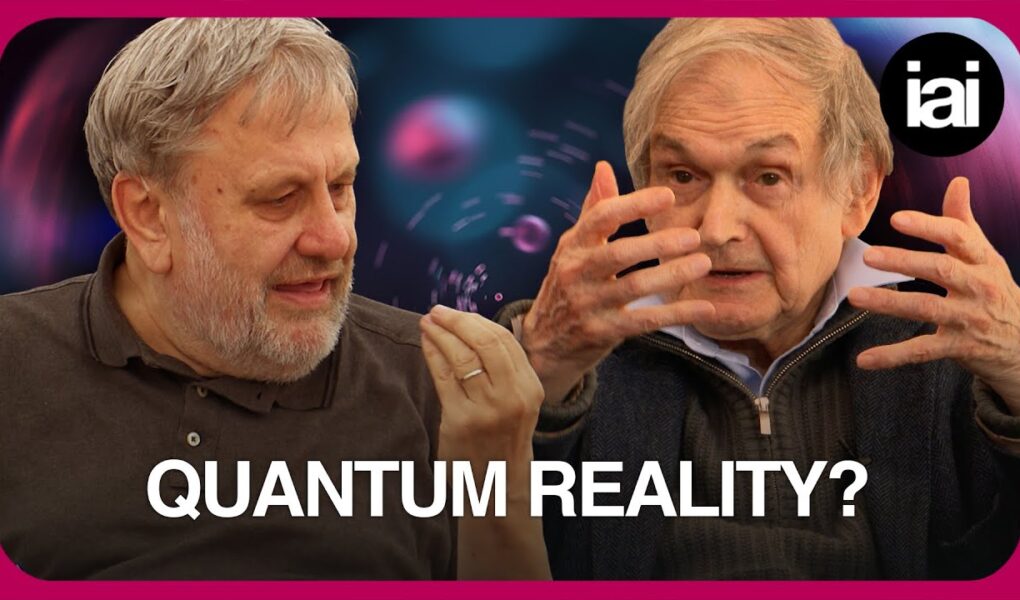
World-leading physicist Roger Penrose and world-leading philosopher Slavoj Žižek thrash out the meaning of quantum mechanics for reality and consciousness.
Does the measurement problem reveal a deeper structure of meaning beyond the calculable laws of physics, or the radical contingency of reality itself?
This is an extract from the debate ‘Quantum and the unknowable universe’. You can watch it now, with a free trial, at https://iai.tv/video/quantum-and-the-unknowable-universe?utm_source=YouTube&utm_medium=description&utm_campaign=h2h
“The more success the quantum theory has the sillier it looks”, wrote Einstein in a letter in 1912. Since then, quantum physics has been verified by experiment and been central to many of the scientific and technological advances of the last century. But the problem that troubled Einstein remains: quantum mechanics renders the universe fundamentally unknowable. Heisenberg’s Uncertainty Principle means that science is, even in principle, unable to predict with certainty behaviour at a quantum level. Heisenberg concluded: “the atoms or elementary particles themselves are not real; they form a world of potentialities or possibilities rather than one of things”.
Should we accept that the quantum mechanics has made the universe unknowable? And if so, how should we proceed if the way the world is depends on our observations? Is science at play in a world of competing models none of which can ultimately describe the universe, or is Einstein’s hunch right and can we uncover a theory that eliminates uncertainty and enables the correct description of the universe independent of any observer?
#physics #philosophy #quantummechanics #zizek #penrose
Roger Penrose is a world-renowned mathematician, mathematical physicist, philosopher of science and Nobel Laureate in Physics. He is best known for his work on general relativity and sharing the Wolf Prize for Physics with Stephen Hawking for his work on black holes. Additionally, he is author of The Road to Reality, Cycles of Time and Shadows of the Mind.
Slavoj Žižek is a globally renowned philosopher and cultural critic. He is international director of the Birkbeck Institute for the Humanities at the University of London, visiting professor at New York University and a senior researcher at the University of Ljubljana’s Department of Philosophy. He is the author of several books, including The Sublime Object of Ideology, The Parallax View, and Heaven in Disorder.
Hosted by Güneş Taylor, training fellow at the Francis Crick Institute, the London-based biomedical research centre.
00:00 Introduction
00:14 Roger Penrose on consciousness
03:50 Slavoj Žižek on consciousness
05:54 The observation problem
The Institute of Art and Ideas features videos and articles from cutting edge thinkers discussing the ideas that are shaping the world, from metaphysics to string theory, technology to democracy, aesthetics to genetics. Subscribe today! https://iai.tv/subscribe?utm_source=YouTube&utm_medium=description&utm_campaign=quantum-and-the-unknowable-universe-h2h
For debates and talks: https://iai.tv
For articles: https://iai.tv/articles
For courses: https://iai.tv/iai-academy/courses
Source

What, if anything, does quantum physics tell us about consciousness? Leave your thoughts in the comments.
This is an extract from the debate 'Quantum and the unknowable universe'. You can watch it NOW, with a free trial, at https://iai.tv/video/quantum-and-the-unknowable-universe?utm_source=YouTube&utm_medium=pinned-comment&utm_campaign=h2h
I used to study physics at university, i'm cureently in my final year of a philosophy and psychology degree. Physicists would benefit a lot from a philosophy education. It has helped me understand the presuppositons and deeper implications of physics theories. It's a shame how dismissive they are of non-stem subjects. I used to act similarly when I was a stem student and its just pure ignorance stemming from an intelectual superiority complex.
Zizek is literally wrong about everything and materialism is false.
OKAY sLAVOj U ARE OUT SCREAMING
🍀🦋
Zizek’s thoughts is indeed a living example of what he himself is saying: malfunctioning
Mr. Penrose is chasing his own tail.
It's not the observation that collapses a wave function
but it's the collapse of a superposition, coming out of the Multiverse, which enables us to observe an event, that is because we don't have a QM computer that can model a Multiverse to a sufficient degree.
As for Zizek. Absolute power house.
Consciousness is deeply flawed as are all animals and biological constructs. Nothing to disagree with. And Lenin. He stood out and away from the events. Aka. Lenin didn't want to personally kill the Romanov's
or take responsibility for any setbacks in the revolution because the ultimate goal was a paradise on Earth.
Why is this behind a paywall!!! You are the problem.. keeping knowledge behind a paywall?
Sabine does not look happy, at all.
Roger only demonstrated that after when the wave function collapses in a particular system where we can see some result unfolding there is a certain point where there is no way of knowing where it will end up, where it will going or how things work given enough time. In some cases based purely on the complexity of the system it is impossible to know anything about the system even from very early on
Donroger Penrose and Sabine Hossenfelder a show where they take down any guest they invite?
Wtf.
When a philosopher and a scientist meet, the philosopher is done.
This Žižek guy is a typical leftie know all, with the unavoidable vehemence, if not violence.
I completely understand consciousness.
The first acknowledgement you do not understand something is when you theorize about something. It is even more a statement when there is courses on philosophical physics. To be clear. One says he thinks… the other mentions reputable historical physics step stones like Shrodinger, Girdle's theorem, collapse of the wave function…
Žižek, kada nekome Bog da disharmoničnu pojavu i kod koga je naglašena disonanca – to je ujedno i njegova legitimacija.
Oprosti ali čini mi se da je to istina.
Zizek needs to do ayahuasca so he can prove himself wrong
how bizarre to put together Penrose and Žižek
Penrose wasting time on a verbal gymnast… Physics is far truer than Stupid Hegel Lacan nonsense
Thanks for the dubbed video!
What an all stars debate!
Com is like or even worse than nazism,a serious scientist like penrose shouldn't debate with a radical left political activist clown who can't even pronounce the English language properly.
The philosopher is not contributing anything useful to the conversation.
He doesn't know anything about physics.
Carlo Rovelli made the same criticism of Lenin in his Helgoland book from a few years back. Idealism disguised as materialism.
They’re both missing deeper issues
Atheist ideology taking its final breaths. 😂
lmao what the hell is zizek even talking about, just look at sabine hahaha
Hate from mexico since u didnt uploaded freely ❤
all your questions answered on the other side of the paywall lol
it is such a loss when a genius accepts that he is a genius and starts thinking that every thought that occurs to him must be true. it even happened to einstein. but penrose lost the capability of doubt tragically early.
How do we realise a quantum like we try to realise god ❤❤🎉🎉
🤣🤣
Ironic how an organisation called Institute of Art & Ideas is locking ideas and debates behind a paywall.
Why don't we get to hear from Sabine too? Is she behind your wall too?
Slavoj jisesk never learned math… RIP
I have also a philosophical Channel ! Love your content . Thank you !
Žižek makes so much sense it is too bad Lenin did not know about the quantum states.
Žižek thinks consciousness is just a brain glitch that happens to be useful, like stumbling on fermented food by accident. But that ignores the fact that consciousness isn’t just some random malfunction—it has deep biological and neurological roots. If it were just a mistake, it wouldn’t be so consistent across all humans, and it definitely wouldn’t show signs of complex organization in the brain. He’s good at metaphors, but this one doesn’t hold up.
And then there’s his whole idea of linking mental disorders to a 'spectrum of consciousness' as if that somehow explains what consciousness is. But that’s just another way of dodging the real question. Instead of looking at where consciousness actually comes from, he just treats different psychological conditions as different 'versions' of it, without explaining why consciousness exists in the first place.
I have a higher universe definitely, but in Super Professor of Philosophy definitely has one too. This is for me is subjective but good while the subjective bad is the deadlock of my predicament
Why am I getting Farnsworth vs Wernstrom vibes
Sir I wanted done the some experiment of human neurones system and consciousness of mind.
This experiment is similar like young double slit experiment but some changes like ray of light passing through the slit where two tiny holes but in this experiment human body provide certain conditions that his soul. don't differentiate between real and imaginary World. It's acc like ear of light or Photon. When ray of light passing through these tiny holes they show interference pattern of these screens . But. in human case consciousness is the acts like tiny holes when a human thought passing through the consciousness also interference pattern form but it can't be seen certain screen just like double slit it can be seen only with the help of high technology computer Power which capable to convert the human language into binary language.
This experiment help to understand behaviour of the classical wavefunction these behaviour of wavefunction so large amount energy emit but we don't know at that time.
You don’t need quantum theory to explain creativity and randomness in a brain. Every sensual stimulus is enough to trigger the vast unpredictability of our thinking processes. I don’t get what they are trying to find
What are they talking about? Consciousness is an exclusive subjective experience. It’s not a phenomenon of the real world. I cannot know if any creature besides me has consciousness! No human, no animal or AI can ever prove to me that they actually experience consciousness as I do. They could in the end fake it all together. And for LLMs already today that would be an easy exercise. That’s why we have the Turing test. Why isn’t that obvious for everyone?
WTF does Zezek knows about QM?
Anyone know where to find the full video
Nice to see Zizek finally out of his depth.