Santa Fe Institute
May 9,2017
Caught in the Pulpit: Exploring the Journey from Religion to Reason
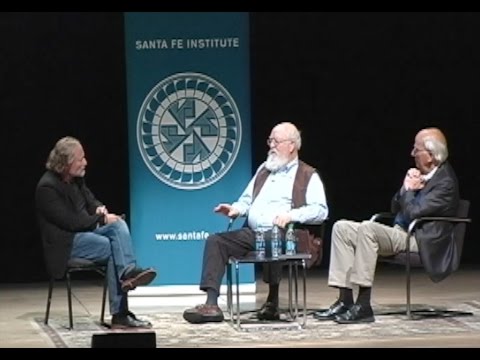
A play by Marin Gazzaniga based on the book by Daniel C. Dennett and Linda LaScola, with discussion
What does it mean to struggle with the idea that there is no God when your life has been devoted to preaching that there is? This is the quandary clergy find themselves in when they go from believer to atheist while they are on the job. Marin Gazzaniga’s play — based on interviews of clergy by Linda LaScola for a Tufts University study she conducted with Daniel C. Dennett — explores the mental anguish and struggles of seven clergy, interviewed privately in hotel rooms around the country, as they reveal personal feelings they’ve never shared. The audience is led on an intimate psychological journey as these individuals struggle with a taboo subject: what’s at stake if you publicly say you don’t believe in God. In hearing their stories, we are challenged to re-examine deeply help assumptions about religion and belief.
In this special event, part of SFI’s 2017 Community Lecture Series, actors will present select scenes from Gazzaniga’s play, followed by discussion with cognitive scientist and philosopher Dennett (an SFI external professor) and Michael S. Gazzaniga, a cognitive neuroscientist (and the playwright’s father), about what brain-mind mechanisms might be at work in religious belief — and the implications for individuals and society.
The performance will feature actors Sabina Dunn, Charles Gamble, Campbell Martin, Hania Stocker, and Elizabeth Wiseman.
Source

Very insightful observations by professor Dennett etMr.Gazzaniga.
The man playing the part of minister Adam at 1:09:00 talks of his worries about speaking openly of his ideas about religion. The funny thing is that unless you were to be outspoken nobody in the church is going to receive a supernatural word of knowledge that you think the scripture stories are largely fictional. I suggest that this is because there is no real supernatural realm.
Daniel Dennett has a point that there is no easy way to say to others that the religious ideas they hold are false however it could help to avoid making sweeping generalisations. Smart people cherry pick the best bits from scripture as ideas that can be guide marks to living. Other parts can be like examples that you see as being overly severe or uncivilised which you aim to avoid living like and try to think of better ways of dealing with the situation.
Exploring the now not so secret world of atheists in the pulpit. Well done.
Dennett is the man. Love his writing and his very relaxed conversational style lectures.
Be great if not for the annoying long winded play stuff
Very interesting, thanks to alL!. I searched for the Pontificia Academy study/conference Michael Gazzaniga refereed to, where J. Eccles and Roger Wolcott Sperry (1913-1994) presented their ideas.
In 1964 there was a conference on BRAIN AND CONSCIOUS EXPERIENCE. Study Week September 28 to October 4, of the Pontificia Academia Scientiarum.
QUESTION: Is this the one? Or there was another one in 1962?
See:
https://link.springer.com/content/pdf/bfm%3A978-3-642-49168-9%2F1.pdf
https://physoc.onlinelibrary.wiley.com/doi/pdf/10.1113/expphysiol.1967.sp001907
NOTES:
Eccles, The Understanding of the Brain (1973): "Now before discussing brain function in detail I will at the beginning give an account of my philosophical position on the so-called 'brain-mind problem' so that you will be able to relate the experimental evidence to this philosophical position. I have written at length on this philosophy in my book Facing Reality. In Fig. 6-1 you will be able to see that I fully accept the recent philosophical achievements of Sir Karl Popper with his concept of three worlds. I was a dualist, now I am a trialist! Cartesian dualism has become unfashionable with many people. They embrace monism to escape the enigma of brain-mind interaction with its perplexing problems. But Sir Karl Popper and I are interactionists, and what is more, trialist interactionists! " see https://en.wikipedia.org/wiki/John_Eccles_(neurophysiologist)
In 1954, Sperry accepted the position as a professor at the Caltech where he performed his experiments with Michael Gazzaniga. see https://en.wikipedia.org/wiki/Roger_Wolcott_Sperry