Big Think
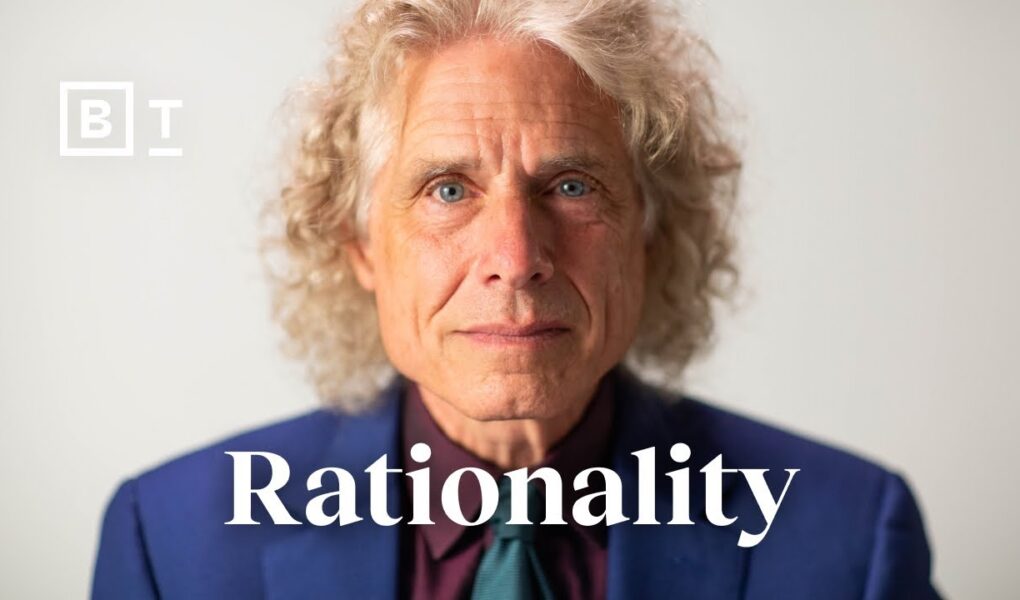
Harvard professor Steven Pinker explains how to develop a rational mind in 80 minutes.
Subscribe to Big Think on YouTube ► https://www.youtube.com/channel/UCvQECJukTDE2i6aCoMnS-Vg?sub_confirmation=1
Up next, Linguistics as a window to understanding the brain ► https://youtu.be/Q-B_ONJIEcE
Steven Pinker, a renowned Canadian cognitive psychologist and author, speaks to Big Think in this wide-ranging conversation on topics such as human progress, the tragedy of the commons, Bayesian reasoning, and strategies to curb our most destructive instincts, with the ultimate goal of improving the world for everyone.
Central to Pinker’s argument is the promotion of rationality. His 2023 book, Rationality: What It Is, Why It Seems Scarce, Why It Matters, delves into the enigmatic nature of human progress, examining how we have achieved so many impressive scientific breakthroughs while concurrently succumbing to widespread irrationality, like fake news and conspiracy theories. Pinker maintains that humans are not innately irrational; instead, our thought processes are better adapted to low-tech environments.
So, how can we cultivate greater rationality in today’s complex world? Pinker believes that one key lies in improving education. By teaching children critical thinking skills, we can better equip them to identify biases, emotional reasoning, and cognitive distortions. A more effective educational approach might emphasize probability theory, the elements of persuasive rhetoric, and developing empathy by understanding the perspectives of those with differing viewpoints. By fostering these skills, we can nurture a more rational and informed society capable of addressing the challenges of our modern era.
0:00 Meet Steven Pinker
0:25 Why does rationality matter?
3:44 How can we measure human progress?
10:17 Is your view of progress optimistic?
12:12 Are we a rational or an irrational species?
18:29 What are the current threats to rationality and progress?
23:41 Why do new technologies tend to increase irrational thinking?
26:05 How do institutions both enable and hinder progress?
29:57 How does cancel culture stifle rationality?
32:14 What are “tragedies of the commons” and how can they impede progress?
35:58 Do “tragedies of the commons” contribute to political polarization?
37:23 How can narrative thinking skew our perception of the world?
39:51 What are cognitive illusions and do they explain irrationality?
44:49 What is Bayesian reasoning?
50:34 What’s a situation where people tend to neglect Bayesian reasoning?
55:53 Why is Bayesian reasoning indispensable for scientists and AI researchers?
56:42 How useful is Bayesian logic for everyday reasoning?
59:25 Why is it so hard to get people to use Bayesian reasoning?
1:00:29 When can a focus on Bayesian reasoning become problematic?
1:04:20 Why do some journalists and scientists forego Bayesian reasoning?
1:08:22 Is the media responsible for our inability to employ Bayesian reasoning?
1:10:08 Can you simplify Bayes’ theorem for us?
1:10:59 Can we become more rational?
1:17:03 Do we have what it takes to be collectively more rational?
Read the video transcript ► https://bigthink.com/series/the-big-think-interview/ultimate-guide-to-rationality/?utm_source=youtube&utm_medium=video&utm_campaign=youtube_description
———————————————————————————-
About Steven Pinker:
Steven Pinker is an experimental psychologist who conducts research in visual cognition, psycholinguistics, and social relations. He grew up in Montreal and earned his BA from McGill and his PhD from Harvard. Currently Johnstone Professor of Psychology at Harvard, he has also taught at Stanford and MIT. He has won numerous prizes for his research, his teaching, and his nine books, including The Language Instinct, How the Mind Works, The Blank Slate, The Better Angels of Our Nature, The Sense of Style, and Enlightenment Now: The Case for Reason, Science, Humanism, and Progress.
———————————————————————————-
About Big Think | Smarter Faster™
► Big Think
Our mission is to make you smarter, faster. Watch interviews with the world’s biggest thinkers on science, philosophy, business, and more.
► Big Think+
Looking to ignite a learning culture at your company? Prepare your workforce for the future with educational courses from the world’s biggest thinkers. Trusted by Ford, Marriot, Bank of America, and many more. Learn how Big Think+ can empower your people today: https://bigthink.com/plus/?utm_source=youtube&utm_medium=video&utm_campaign=youtube_description
Source


How do you think we can become more rational?
Steven Pinker sounds like Ze Frank, I can't unhear it
It's a bugs life frfr.
Zionism is not rational though is it? WHy the silence?
This video hits really hard right now. Some of it would have felt on point at the time but feels slightly naive now, not understand how fragile our law are.
This should be required watching . Rationality should be required for every high school student
Rationality is the problem. What we need is more Reason.
14:08 Man, My guy knows the reddit deep lore XD
Isn’t this the same guy who supports Israel in its genocide? Yeah it is
Thank you very much, prof. Stephen Pinker!!!
Transformar as a sociedade mais conscientes em seus juizos.
Societies are collective delirioums. Rationality and objetivity are always delimited within the boundaries of those delirioums.
Rational = got to work, dont question your overlords .. eh?
Alot of misinformation in this guy… seriously sir, have you gone to poor countries?
The informations of this guy is alarmingly troubling.
I think we peaked
What is the real treatment for bullying, teacher?
쇼펜하우어 등 수많은 고전에서 인생은 개고생이라고 함. 원래 멍청한 사람들이 대대로 후대를 고생시키는 것임! 군인이나 납세자 노동자들이 필요한 사기꾼 정치인들이 살아남은 사람들이 승자라고 선동하고 교과서에 실어 가르치고 거짓말한 것임! 이걸 모르고 그대로 따라서 믿는 사람들이 돌대가리들임! 이런 돌대가리들이 지적 허영과 우월감에 빠져 배운 것을 뽐내는 것이 인간이란 존재임. 인류역사를 조금만 살펴보면 금방 알 수 있음. 인류의 지식이라는 것은 그들의 자의적 견해며 해석이지 이를 절대적 지식으로 착각하는 자랑스러워하는 돌대가리들이 차고 넘치는 것이 너무 어이가 없음.
Watching Steven Pinker discuss "Rationality," armed with charts and references to human progress, while Israel and Iran exchange fire, Gaza lies in ruins, Sudan bleeds in silence, Syria limps from years of war, Libya remains fractured, and Ukraine is still under siege is like listening to a weather forecast of sunny skies while the world outside is engulfed in a storm. Statistics may show progress, but reality feels anything but rational.
Pinker is eloquent truth seeking humble humourous and brilliantly insightful. We are lucky to have him
People aren't searching for truth, they are weak – they are searching for validation.
Reason is a function. In The Age of Reason it was given God-like status; that did not always work out too well. We are, not as atheistic materialism see us; two dimensional: elemental or physical beings: elements and reason but triune: consciousness; mind; elements. We inhabit three dimensions not just one; the elemental. It is likely that consciousness (currently ‘the hard problem’ for atheistic philosophers) is fundamental and that mind is subtly elemental emerging with quantum events with the macro elements.
Consciousness; mind; elements. Rationality should be balanced by feeling; they are opposite aspects of consciousness and mind. In all disciplines: Religion; philosophy; psychology the advice has been to negotiate a path between opposites; reason and feeling. It is called The Middle Way. Reason and rationality in the West has augmented matter to be fundamental to reality not just to physical reality. It has split the atom and given us nuclear energy and it has boons and also its bane which could be annihilation if misused or by accident.
We are at a turning point as we explore space; the fifth and last macro element. What lies beyond likely hyperspace may be where causality lies. It is unlikely we will ever take our elemental selves there as its energy would be too subtle for our elemental or physical selves to enter. With the discovery of finer forces we are making inroads into heaven but because it is unity and our earthly selves and the elemental system we are under is a dual system, we have to shed out bodily coats before we enter.
We may be done with the supremacy of rationality; it can take a Frankenstein-ish turn if it runs amok. Atheists love it, as in addition to the elements, it is the only aspect of the human that it acknowledges. Except sociobiology does not acknowledge it. The religious or intuitive self; consciousness (the hard problem for philosophy) is given short shift and ignored by materialism; it may give humanity short shift. Except recently with philosophy having “the hard problem of consciousness” it is beginning to be acknowledged.
As humanity makes its way into space; fueled not by reason alone, but also by the intuition that it downplays and outright denies: the religious aspect of our nature. Let us, if not bury the god of reason; at least rein it in; before as with the atheistic ideologies of communism (defeated); eliminative materialism; and next up trans humanism; it attempts to rein us in or even bury us; the conscious; intuitive; feeling part of our nature it does not understand.
🧠🙏🏼
Anti trans bigot wearing a wig
Wonderful explanations. Thank you very much for that. However, I had the feeling that Professor Steven Pinker is explaining the strategy the universe uses to make us better and better, considering our primal impulses as a starting point in time. In my infinite ignorance, I understood everything that was said as a strong argument in favor of what he said he doesn't believe. Perhaps our rationality is the next stage in our evolutionary progress that is built by a selective ethical, and moral process that is a natural part of a strategy of the evolutionary process. If so, and I believe we have strong evidence of this in all the results coming from the mass extinction processes on this planet; embarrassment, suffering, and fear play a strategic role in our evolution. At least until we can learn how to overcome these natural strategies of the universe. I believe, and I may be making a huge mistake, that the closer we are to the animals, the stronger the suffering is because of natural laws that support an inviolable balance between mind and body, instinct and consciousness always as an impetus forward, and this is how life improves itself indefinitely. However, the more significant our rationality is, the more intense the moral suffering will be because skills like empathy are also becoming wider and deeper. Dear Professor, once again, thank you very much for your explanations.
0:01. HARVARD = JUNK.
You forgot to mention israel and how it contributes for the number of wars and deaths, just like the US
Its shameful the amount of commercial ads this vidro has. Blocking. I do not recommend this vhannel.
Interesting video until he got into politics. Unfortunately, just another case of leftist denial from Harvard. Sad…
You say you don't believe in anything that has to be believed in, and that you don't believe there is an arc of the universe bending towards justice, but the quote is that the arc of the moral universe bends towards justice. It's not the physical universe. I think of it as the metric of our attempt to bridge the distance between our slow personal and institutional evolution trying to catch up with our technological trajectory and social momentum.
And now, only a few years later, the Americans are turning on each other…
Great boots Steve!
Steven pinker for the win
Racism has not decreased.. it's merely suppressed.
… and then 2025 happened 😢