Manhattan Institute
Nearly 60 years after the passage of the Civil Rights Act of 1964, the goal of living in a colorblind society remains stubbornly out of reach. Recent polling revealed that Americans are more pessimistic than optimistic about the country’s ability to ensure racial equality of all people regardless of race or ethnicity. What has led many Americans to have such a dismal view of race relations? In what ways have policies and institutions strayed from working towards a colorblind ideal?
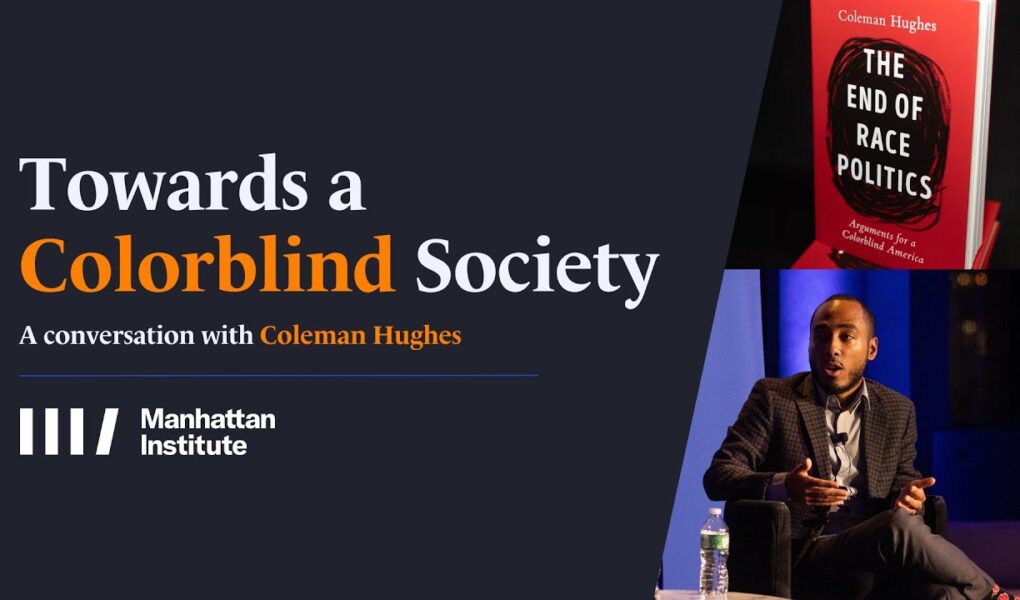
In a new book, Coleman Hughes argues against the rise of the anti-racist movement, which in Hughes’s view has only led to more grievance, victimhood, and marginalization among Black Americans, rather than prosperity and upward mobility. The pursuit of anti-racist policies—including those under the banner of Diversity, Equity, and Inclusion (DEI)—will only create the illusion of racial equality without leading to any substantive change.
Hughes discusses the abandonment of colorblindness as an aspiration; how Americans can reflect constructively about race relations and their own lived experience; and the prospect of achieving true equality and progress.
Source



NOTE: Please stand by momentarily as our cameras focus at the start of this video.
Thanks Coleman.
My dad was red/green color blind and when he got dressed up, he was not fly.
This was a fantastic discussion. I am impressed and excited to read your book. I hope your insights and ideas gain traction.
Features Coleman Hughes therefore I must watch it. It's like math. A true rock star thinker, writer and speaker. Best wishes from a guy in Canada.
There are no bad effects created by modern technology like social media. There are only bad effects from the way some humans haven’t matured enough to act responsibly when using the tech. The solution is not to penalise tech companies but to raise the standard for what we expect from our fellow citizens.
I think progressive criticism of "colorblindness" is heavily misunderstood. Every progressive subscribes to "colorblindness" as an ideal but an ideal is not reality but rather a state of being to work towards. At a minimum, it's not a state that society is presently ready for. I mean, we had relative colorblindness for ~20 years and there has been no meaningful improvement in racialized outcomes so it's clear this simply hasn't been working and a different tact is needed.
Coleman Hughes is another on the path begun by Booker T Washington
Very thoughtful and enlightening talk.
Coleman is (truly) a national treasure. He brings out the best in me, in all of us. 💜
We will never have a colorblind society. Never. Racism is woven into the fabric of the USA. Racism has always benefited the White mainstream society. So, there will be no colorblind society for this country.
Thank you for trying, Coleman.
Why is a colorblind society controversial, it has been the unstated goal since 1964. What changed that and why?
Brilliant conversation and some (unusually) concise and thoughtful questions.
Thank you Coleman and Reihan for elevating this topic beyond the banal and tribal dimensions 👏🏼👏🏼