The Institute of Art and Ideas
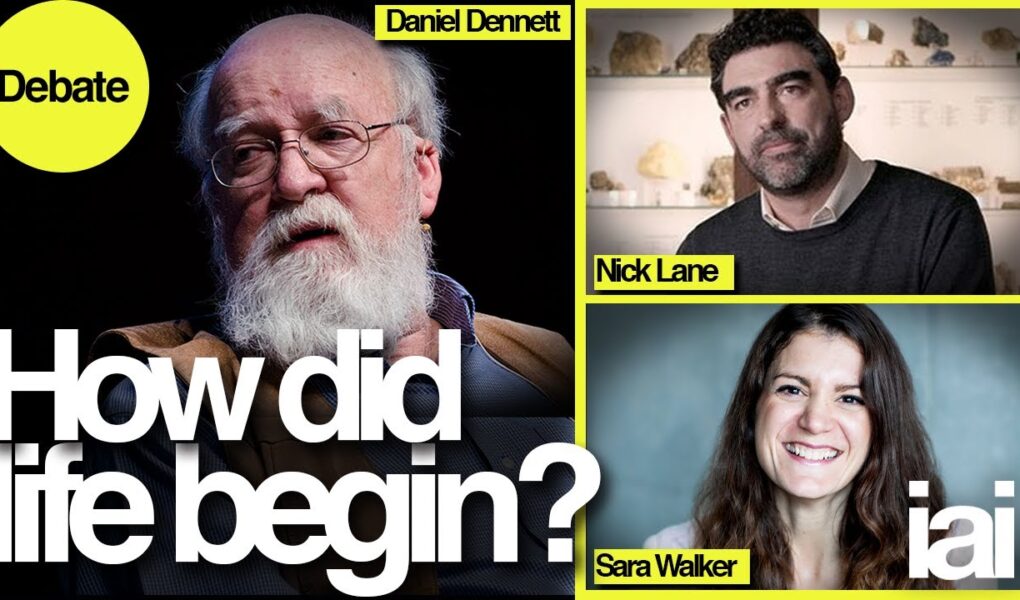
Daniel Dennett, Nick Lane and Sara Walker discuss whether we are looking at the origin of life wrong.
Watch the full debate at https://iai.tv/video/chicken-or-egg?utm_source=YouTube&utm_medium=description
It is the question that has rocked humanity for millennia, the conundrum that has confounded scientists, philosophers, politicians, artists and everyone in between: which came first, the chicken or the egg? Aristotle postulated that both chicken and egg were essential properties of the universe, extending infinitely back in time. Plutarch argued the question pointed to the bigger question of whether the universe had a beginning.
You might imagine that evolution explains life. But it doesn’t. And scientists remain perplexed as to how and where life emerged. Are we simply the result of a fluke event, one chemical reaction billions of years ago? Are we right to turn to the biologists to tell us, or does the issue in fact lie deeper?
Legendary American philosopher Daniel Dennett, astrobiologist and famed science communicator, Sara Walker, and evolutionary (and revolutionary) biochemist Professor Nick Lane tackle the most fundamental question of all. Hosted by Güneş Taylor.
#DanielDennett #originoflifebiology #sciencephilosophy
Daniel Clement Dennett III is an American philosopher, writer, and cognitive scientist whose research centers on the philosophy of mind, philosophy of science, and philosophy of biology, particularly as those fields relate to evolutionary biology and cognitive science. Dennett is referred to as one of the “Four Horsemen of New Atheism”, along with Richard Dawkins, Sam Harris, and the late Christopher Hitchens.
Nick Lane is Professor of Evolutionary Biochemistry in the Department of Genetics, Evolution and Environment at University College London. His research focuses on the way that energy flow has shaped evolution over 4 billion years, using a mixture of theoretical and experimental work to address the origin of life. He is Co-Director of the UCL Centre for Life’s Origin and Evolution (CLOE) and is the author of four acclaimed books on evolutionary biochemistry, which have sold more than 150,000 copies worldwide.
Sara Walker is a famed science communicator, theoretical physicist and astrobiologist with research interests in the origins of life, astrobiology, physics of life, emergence, complex and dynamical systems, and artificial life. Walker is currently the Deputy Director of the Beyond Center for Fundamental Concepts in Science at Arizona State University, Associate Director of the ASU-SFI Center for Biosocial Complex Systems and an associate professor at Arizona State University (ASU).
Visit IAI.tv for our full library of debates, talks, articles and podcasts from international thought leaders and world-class academics.
The Institute of Art and Ideas features videos and articles from cutting edge thinkers discussing the ideas that are shaping the world, from metaphysics to string theory, technology to democracy, aesthetics to genetics.
For debates and talks: https://iai.tv
For articles: https://iai.tv/articles
For courses: https://iai.tv/iai-academy/courses
Source
It appears that oxygen was being produced on Earth 4.1 – 4.2 billion years ago (hematite in Quebec rocks; zircon evidence for Earth atmosphere oxidation). This implies the existence of photosynthesis 4.1 – 4.2 billion years ago. Photosynthesis is one of the most complicated chemical processes in nature. The most likely photosynthesis organism is cyanobacteria which we have fossil evidence for that is 3.7 billion years old. Cyanobacteria exist today. That means we have a 3.7/4.2 billion years of unbroken chain of DNA of parent/child for cyanobacteria. It was a single celled organism 3.7/4.2 billion years ago and it is still a single celled organism using photosynthesis to create oxygen. How could something as complicated as photosynthesis be in existence on planet Earth 4.2 billion years ago?
This entire question hinges on faith in the reflective observer, the ego. This imagined observer seeks to understand the origins of the material world after presuming itself as a real, separative, unbiased observer. Is it? Shocking to hear the Tufts professor say that philosophy has no place in these theories when this totally philosophical starting-point has not been settled at all!
… Any brainy folks anywhere, what do you think of the Theory, that the plain of jars are most plausibly giant commemorative poppy pod shaped household opium containers, scattered randomly, like opium poppies in a field are?
"The Ebner Effect", Magnetism.
For Nick the problem is to go from hypothesis to a theory, for Sara it is more or less the same, for Daniel the problem is simpler, he runs an institution the pays believers to convert into atheist who believes (without a theory that luck or an accident) got life going.
9:15 Emergent laws may make fully understanding life impossible. Humankind can get close though
No worries about this. I know the answer. Just read Genesis chapters 1 and 2 in the Bible. Thank you for asking.
2:44 me when someone asks if the chicken or the egg came first
Ignorance is bliss for Dan Dennett and his friends, no doubt. He is stubbornly stupid to the point that is comically embarrassing in this day and age… You might have a lot of white beards Dan, but honestly you also need to grow up intellectually, and stop being so narrow minded. I know you have an agenda and community to run that feeds and funds a lot of like-minded colleagues of yours; and I know you are a pious man when it comes to your beloved faith (Atheism). But at least try to behave a little more open minded on camera, nothing is necessarily binary in this world, you don't have to belong to either Atheism or Theism wagon mate. This is honestly so embarrassing to watch… "…We are robots made of robots made of robots made of robots"… Ok I guess ^^… /facepalm
On a serious note, and although it's a broad topic and a complex one indeed, but I think this short quote from Dennett and the response from Nagel (which I'm not necessarily agree with all his approach either) is enough to show how arrogant, stubbornly ignorant and agenda-driven Dennett is:
Dennett says and I quote: "Brains are syntactic engines that can mimic the competence of semantic engines. The appreciation of meanings – their discrimination and delectation – is central to our vision of consciousness, but this conviction that I, on the inside, deal directly with meanings turns out to be something rather like a benign "user-illusion". There are so so many contradictory parts here and numerous paradoxical problems that I don't even know where to begin!
And Nagel responds by stating: "Dennett asks us to turn our backs on what is glaringly obvious—that in consciousness we are immediately aware of real subjective experiences of color, flavor, sound, touch, etc. that cannot be fully described in neural terms even though they have a neural cause (or perhaps have neural as well as experiential aspects). And he asks us to do this because the reality of such phenomena is incompatible with the scientific materialism that in his view sets the outer bounds of reality. He is, in Aristotle’s words, “maintaining a thesis at all costs.”
He adds: "To say that there is more to reality than physics can account for is not a piece of mysticism: it is an acknowledgment that we are nowhere near a theory of everything, and that science will have to expand to accommodate facts of a kind fundamentally different from those that physics is designed to explain. It should not disturb us that this may have radical consequences, especially for Dennett’s favorite natural science, biology: the theory of evolution, which in its current form is a purely physical theory, may have to incorporate nonphysical factors to account for consciousness, if consciousness is not, as he thinks, an illusion. Materialism remains a widespread view, but science does not progress by tailoring the data to fit a prevailing theory."
For those open minded enough and knowledgeable enough to understand the technicalities, let these sink, and then think about WHY Dennett still has so many sheeple followers… It's beyond absurd at this point.
A 10 minute video on a question like this just isn't worth watching!
Notice how Nick or Daniel never got switched to full screen 😂
We love you Sara😘
First two pitches, yawn, the third, now I'm listening
Wrong, – Life is Eternal, so there is No beginning.
Evolution have to do with development,
Life and Consciousness, cant be created, only renewed and developed.
First guest missed her point.
The hypothesis that life could begin in hydrothermal vents with all the dilution of ocean water compounding a lack of enough substrates is preposterous. Life began in shallow freshwater pools near volcanoes where the benefits of wet dry cycling and abundant substrates from volcanoes and meteorites make life inevitable.
@Nick Lane. Sir, what is your opinion on Corona virus infiltrating cells? As the mitochondria have become the very essence of our cells, can or will this virus have positive impact on our cells too?
Is Nick Lane going to enter the race vs. Lee Cronin, Jack Szostak, Sara Walker, etc. for the Evo2.0 OOL $10M prize that was announced at the Royal Society a couple of years ago? Could they split the prize? When should we expect the winner to be announced?
Abiogenesis is impossible. Abiogenesis is impossible at the beginning, in the middle and at the end. Chemistry doesn't do what life does as can be demonstrated by observing precisely how a cell happens to go about living and reproducing.
Sara Walker might be a bit uninformed regarding epicycles since she is comparing prescientific speculation to modern chemistry and biochemistry. Not quite analogous for many reasons.
After decades of study and deep thought, i feel i am soooo close to figuring it all out. Here is where i've gotten to…
"Life started just before it began"
Something isn't quite right there, i know, but i just can't put my finger on it. I'm bound and determined to, and if it takes me another 40 years shut up in my study to finally tie it all together then so be it. I do this not only for myself, but for all of mankind.