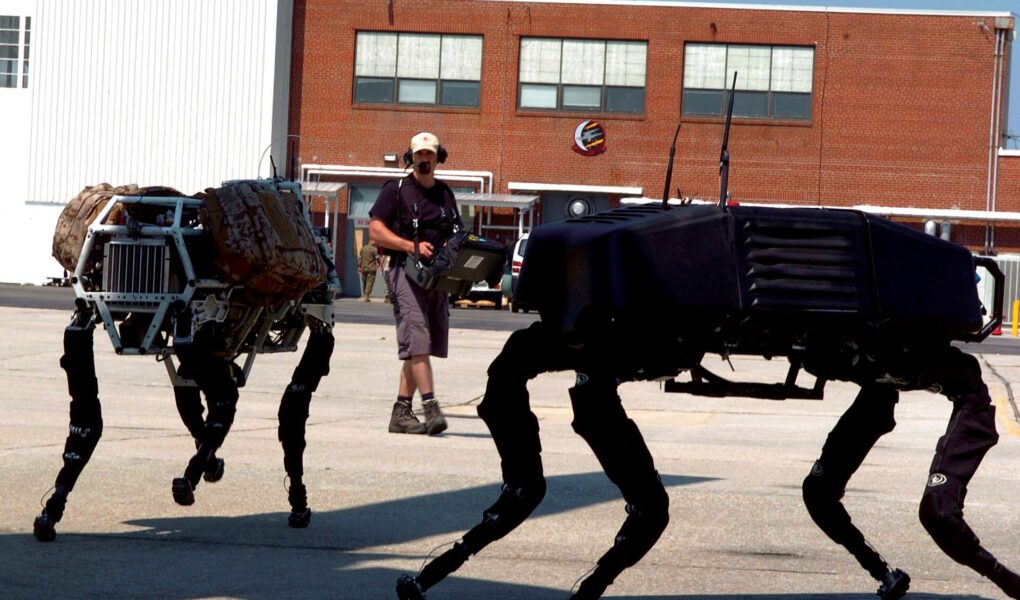
If you were online in the late 2000s, you may remember a video of a headless, four-legged machine trotting across a parking lot. Someone kicks it hard. It staggers, scrabbles, and does not fall. Later in the clip it slips on ice and recovers with a flailing, uncannily animal-like shuffle. That machine was BigDog, and the reason the video unsettled so many people is worth thinking about. We did not find it impressive because it was clever. We found it impressive because it moved like something alive.
The story of how robots learned to move, from BigDog to today’s humanoids, is partly a story of engineering. It is also a quiet lesson about minds.
BigDog: balance before brains
BigDog was created in 2005 by Boston Dynamics, with partners including Foster-Miller, NASA’s Jet Propulsion Laboratory and the Harvard University Concord Field Station, and with funding from the US military research agency DARPA. The goal was a robotic pack mule that could carry gear over terrain too rough for wheels. It was about the size of a small mule, weighed around 110 kilograms, and was powered by a small petrol engine driving a hydraulic pump. An onboard computer read data from dozens of sensors and constantly adjusted its legs to keep it upright.
BigDog’s real achievement was dynamic balance. Earlier walking machines mostly moved carefully, keeping their weight safely over their feet. BigDog, like an animal, was always slightly falling and always catching itself. That is what made the kick video so striking.
It was also loud. Its engine could be heard from far away, which is not ideal for a military vehicle, and the programme and its larger successor, the Legged Squad Support System, were shelved by the end of 2013.
Atlas: from hydraulic acrobat to electric worker
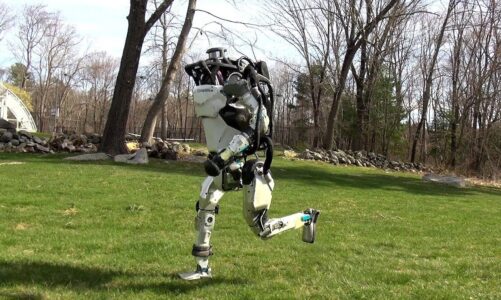
Boston Dynamics unveiled its humanoid robot Atlas in July 2013, developed with DARPA funding and used by several teams in the DARPA Robotics Challenge, a competition to build robots that could work in disaster zones. Early Atlas was tethered, heavy and cautious.
Over the next decade it became a celebrity. In 2017 a video showed Atlas doing a backflip. Later videos showed it running parkour courses and, in a 2020 music video, dancing alongside Spot. These routines were carefully rehearsed, but they showed a humanoid moving with real athleticism.
In April 2024, Boston Dynamics retired the hydraulic Atlas with a farewell video, and the next day introduced a fully electric version. The new Atlas is lighter in look and design, with joints that can rotate beyond human limits, and is aimed less at stunts and more at practical work in places such as car factories run by Hyundai, which took control of Boston Dynamics in 2021.
Spot: the robot dog goes to work
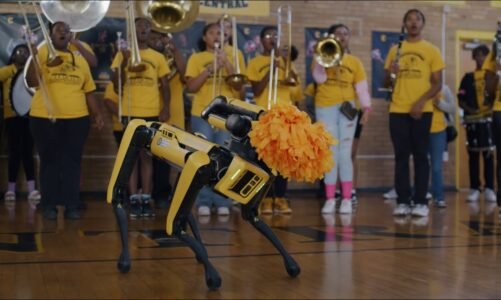
Between BigDog and the electric Atlas came Spot, a smaller, electric, four-legged robot about the size of a large dog. Boston Dynamics began offering it to businesses in 2019 and opened commercial sales in the United States in June 2020, at a base price of $74,500. Spot now does unglamorous jobs: walking around industrial sites, reading gauges, carrying cameras and sensors into places that are dangerous or tedious for people.
The learning revolution
For most of this history, robot movement was largely engineered. Specialists built detailed mathematical models of the robot’s body and wrote controllers that used those models to plan each step. This approach produced remarkable results, but it is labour-intensive and can be brittle when the world does not match the model.
Over the last several years, a different approach has taken over much of the field: reinforcement learning in simulation. Instead of telling the robot how to walk, researchers build a virtual copy of it, give it a goal (move forward, don’t fall, use little energy) and let it try millions of times. Behaviour that brings it closer to the goal is rewarded. Over time, a neural network learns a walking policy on its own.
Simulation makes this practical because virtual robots can fall over endlessly without breaking and can be run far faster than real time. Researchers have shown that thousands of simulated robots can now be trained in parallel on a single graphics processor, compressing what would be years of practice into hours or even minutes.
Sim-to-real: crossing the gap
The catch is that a simulation is never quite the real world. Friction is a little different, motors respond a little slower, the ground is never perfectly modelled. A policy that is brilliant in simulation can fail embarrassingly on the real robot. This is called the sim-to-real gap.
One of the key tricks for crossing it is domain randomisation: training the robot across many versions of the virtual world, with varied masses, frictions, delays and terrains, so it learns to cope with uncertainty rather than memorise one setting. A team at ETH Zurich led influential work here with its four-legged robot ANYmal. In a 2019 paper in Science Robotics, Jemin Hwangbo and colleagues trained control policies in simulation and transferred them to the real robot. In 2020, Joonho Lee and colleagues showed that a controller trained entirely in simulation could carry ANYmal over mud, snow, rubble and thick vegetation it had never encountered in training.
The approach has reached commercial robots too. In 2024, Boston Dynamics described adding reinforcement learning, trained in simulation, to Spot’s walking controller, combined with its existing model-based methods.
What is still hard
Walking is now in good shape. Plenty remains difficult:
- Hands. Grasping varied, soft, slippery or unfamiliar objects is far harder than walking, and touch sensing still lags far behind human skin.
- Reliability and endurance. Battery life, wear and tear, and recovering safely from rare failures all matter more in a factory than in a viral video.
- Working around people. A heavy, fast robot must be predictably safe in shared spaces.
- Combining movement with understanding. Knowing how to walk is different from knowing where to go and why.
My take: the body is not just a vehicle for the mind
In the 1980s the roboticist Hans Moravec pointed out something that became known as Moravec’s paradox: the things humans find hard, like chess and algebra, turned out to be relatively easy for computers, while the things a toddler does without thinking, like walking across a cluttered room, were fiendishly difficult. Robotics since then has proved him right. It took decades of work to get machines to do what a dog does on its first day of running around a yard.
That should change how we think about intelligence. Philosophers and scientists working on embodied cognition have long argued that the mind is not a disembodied program that happens to drive a body around. Much of what we call intelligence lives in the coupling of body, brain and world: in how our tendons store energy, how our balance reflexes fire before we are aware of them, how we understand objects partly through what we can do with them. The roboticist Rodney Brooks made a version of this case in the early 1990s, arguing that robots should be built from the bottom up, through interaction with the real world, rather than from abstract reasoning down.
Modern legged robots offer a striking illustration. Their best locomotion skills are not reasoned out step by step. They are learned through countless physical, or simulated physical, trials, and stored in a form that no one, including the engineers, can read as a set of rules. That looks a lot like how animals, and we, learn to move.
None of this means robots that walk well are conscious, or close to it. But it does suggest that any honest account of minds, natural or artificial, has to start with bodies. Long before a creature can think about the world, it has to stay upright in it.
Further reading
- How the Body Shapes the Way We Think: A New View of Intelligence, Rolf Pfeifer and Josh Bongard (2006)
- Flesh and Machines: How Robots Will Change Us, Rodney A. Brooks (2002)
- Being There: Putting Brain, Body, and World Together Again, Andy Clark (1997)
- The Embodied Mind: Cognitive Science and Human Experience, Francisco J. Varela, Evan Thompson and Eleanor Rosch (1991)
- Mind Children: The Future of Robot and Human Intelligence, Hans Moravec (1988)