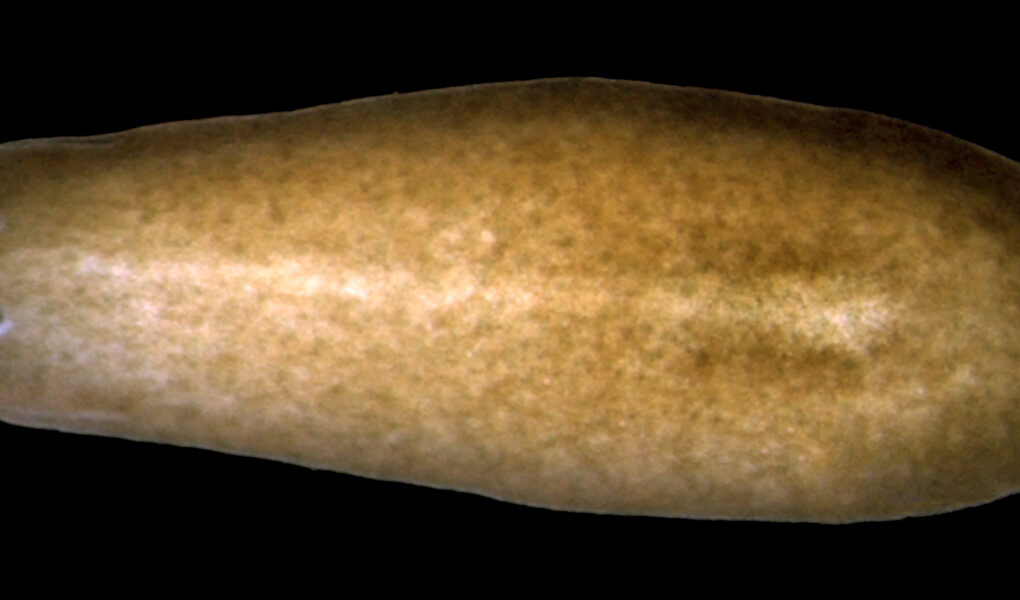
Cut a planarian flatworm into pieces and each piece grows back into a complete worm, head and all. For more than a century biologists have marveled at this. Michael Levin, a biologist at Tufts University, asks a stranger question: how does each fragment know what to build, and when to stop? His answer, that cells and tissues use electrical signals to store and process information about the body, has turned him into one of the most discussed scientists working at the border of biology and mind.
Levin’s work mixes careful laboratory results with very large ideas. Both are worth understanding, and it helps to keep them apart.
Bioelectricity: the body’s other signaling system
Every living cell maintains a small voltage across its membrane, produced by ion channels and pumps that move charged particles in and out. Neurons are famous for using these voltages to send fast signals. Levin’s central claim is that all cells use them, more slowly, as a kind of shared information layer. Cells link up through tiny channels called gap junctions, and the resulting patterns of voltage across a tissue act, in his description, like a map of what the body should look like.
The idea is not entirely new. Researchers such as Robert O. Becker explored the role of electricity in healing decades ago. What is new is the precision of the modern tools: voltage-sensitive dyes that make these patterns visible, and drugs or genetic changes that alter specific ion channels so researchers can test what the patterns do.
The established findings
Here are some of the results that are published in peer-reviewed journals and are not seriously disputed as observations, even when their interpretation is debated.
Two-headed worms that stay two-headed
In a 2017 study in the Biophysical Journal, Levin’s lab, with Fallon Durant as first author, briefly blocked gap junctions in cut planarian fragments. A proportion of them regenerated with two heads, one at each end. More striking, many of the worms that looked normal were not. When they were cut again later, in plain water with no drug, some of them also grew two heads. The altered “target shape” had been stored somewhere other than the genes, and the authors linked it to patterns of cellular voltage. The DNA was unchanged; the body plan the tissue was aiming for had shifted.
Eyes in unexpected places
In frog tadpoles, Levin’s group showed that changing the voltage of cells in regions far from the head could cause eye-like structures to form there, including in the gut region. The finding suggests that a bioelectric state can act as a trigger that says “build an eye here,” with local cells working out the details.
Regrowing a frog’s leg
Adult African clawed frogs cannot normally regrow a lost leg. In a 2022 paper in Science Advances, led by Nirosha Murugan with researchers at Tufts and Harvard’s Wyss Institute, frogs received a wearable silicone cap holding a gel with five drugs for just 24 hours after amputation. Over roughly the next eighteen months, many treated frogs regrew substantial, functional legs. They were not perfect copies, but the short treatment set off a long regrowth process.
Xenobots and anthrobots
In 2020, Levin and the computer scientist Josh Bongard, with Sam Kriegman and Douglas Blackiston, reported “xenobots” in PNAS: tiny living structures assembled from frog embryo cells, with shapes suggested by computer simulation. A 2021 follow-up showed that some xenobots could gather loose cells into new clusters that matured into new xenobots, a form of replication the authors called kinematic self-replication. In 2023, Gizem Gumuskaya and Levin described “anthrobots” in Advanced Science, built from adult human airway cells without genetic modification. In a lab dish, clusters of them encouraged neurons to grow across a scratched gap in a layer of nerve cells, though how they do this is not yet understood.
Memory without the original brain
In a 2013 study, Tal Shomrat and Levin trained planarians to become familiar with a particular environment, cut off their heads, and let them regrow new brains. The regrown worms relearned the task faster than untrained worms. The effect was modest and needs more replication, but it hints that some information can survive outside the brain.
The big ideas
This is where Levin moves from findings to frameworks, and where readers should shift gears.
He argues for what he calls a continuum of intelligence. Intelligence, on his definition, is the ability to reach the same goal by different routes when circumstances change. By that standard, a regenerating flatworm fragment that rebuilds the right body from an unusual starting point is solving a problem. So are cells navigating toward a target shape. Levin calls this “basal cognition,” a term shared with researchers such as Pamela Lyon who study problem-solving in organisms without brains. In a 2022 paper he proposed a framework called TAME (Technological Approach to Mind Everywhere) for studying minds in unfamiliar substrates.
In recent talks and essays, Levin has gone further, speculating that the forms living systems reach toward may be drawn from a kind of abstract space of patterns, a view he compares to Platonism. This is philosophy, not experimental biology, and he generally presents it that way.
What it means for mind
I think Levin’s work matters for the philosophy of mind in two ways, one solid and one still open.
The solid point is that information processing, memory and goal-directed behavior are not exclusive to brains. Bodies are full of systems that store states, respond flexibly and correct errors. That weakens the assumption that the mind begins and ends at the skull, and it suggests that cognition evolved from much older biological tricks rather than appearing from nothing with neurons.
The open question is whether any of this involves experience. Problem-solving is one thing; there being something it is like to be a cell cluster is another. Levin’s work speaks directly to the first. It does not settle the second, and enthusiastic summaries that slide from “cells are intelligent” to “cells are conscious” skip a step the evidence does not take.
There is also a fair criticism to note. Calling cells “intelligent” or “goal-seeking” can be a useful way of predicting what they will do, or it can be a relabeling that adds little. The test is whether the framework leads to experiments that would not otherwise have been tried. Here Levin has a real case: the frog leg and planarian results came from treating tissues as systems that could be persuaded, not just reprogrammed.
My take
Read Levin the way you would read any pioneer: generously, but with two columns. In the first column go the experimental results, which are surprising, published and testable. In the second go the frameworks and speculations, which are bold and worth arguing about but not yet established. The excitement around his work is justified by the first column. Most of the controversy comes from people collapsing the two.
Either way, the lesson for anyone curious about consciousness is humbling. Mind may turn out to be less like a light switched on in the brain and more like a property that comes in degrees, spread through living matter in ways we have only begun to measure.
Further reading
- We Are Electric: Inside the 200-Year Hunt for Our Body’s Bioelectric Code, and What the Future Holds by Sally Adee (2023)
- The Body Electric: Electromagnetism and the Foundation of Life by Robert O. Becker and Gary Selden (1985)
- How Life Works: A User’s Guide to the New Biology by Philip Ball (2023)
- Other Minds: The Octopus, the Sea, and the Deep Origins of Consciousness by Peter Godfrey-Smith (2016)
Image: The planarian Schmidtea mediterranea by Alejandro Sánchez Alvarado, CC BY-SA 2.5, via Wikimedia Commons.