Few ideas travel as well online as this one: in quantum physics, reality does not settle down until someone looks at it. The observer creates the world. Consciousness is woven into the laws of nature. It is a thrilling thought, and it is usually presented as settled science. It isn’t. But it isn’t pure nonsense either, and the real story is more interesting than either the hype or the eye-rolling.
The experiment everyone mentions
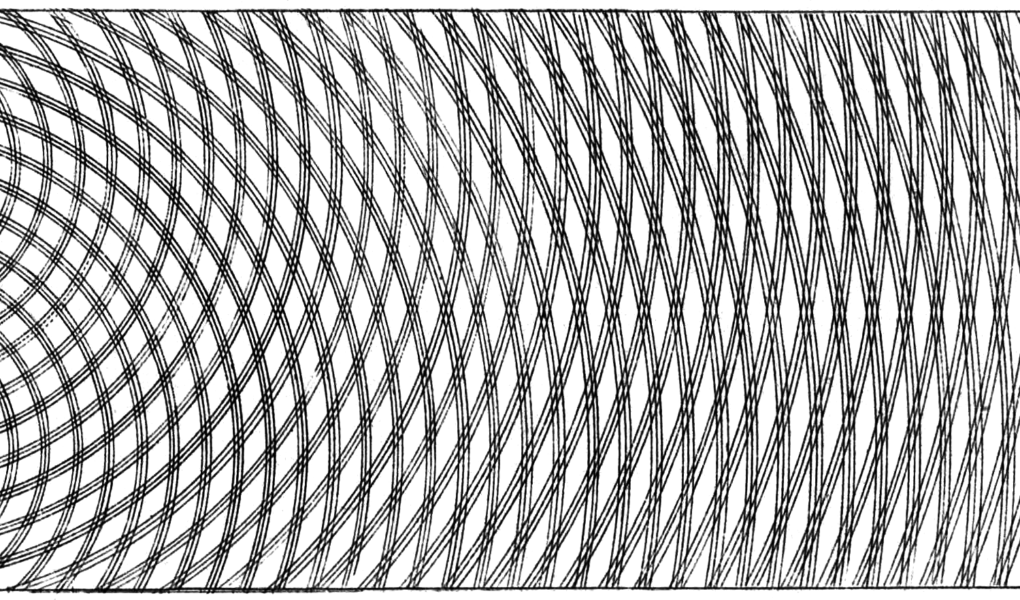
The double-slit experiment goes back to Thomas Young in the early 1800s, who used it to argue that light is a wave. Shine light through two narrow slits, and on the screen behind them you get a pattern of bright and dark stripes. That is interference: waves from the two slits reinforce each other in some places and cancel in others.
The quantum twist came in the twentieth century. Send electrons through two slits one at a time, and each lands as a single dot on the detector, like a particle. Yet after thousands of dots pile up, the same striped interference pattern appears, as if each electron had passed through both slits as a wave. A well-known 1989 experiment by Akira Tonomura’s team at Hitachi showed this pattern building up dot by dot. Similar effects have since been seen with whole molecules, including carbon “buckyballs” made of sixty atoms.
Now the famous part. Put a detector at the slits to find out which one each electron goes through, and the stripes vanish. You get two plain bands, as if the electrons had been ordinary little bullets all along. Looking, it seems, changes the outcome.
What “observation” means in physics
Here is where the word “observer” causes trouble. In physics, an observation or measurement is any physical interaction that leaves a record of which path the particle took. The “observer” can be a detector, a stray photon, or a single air molecule that bumps into the electron. No person has to be watching. In fact, in real experiments no one watches individual electrons at all; the data are recorded by machines and examined later.
What destroys the interference is the information becoming physically available somewhere in the universe, not a mind becoming aware of it. If which-path information is recorded in the environment, the stripes disappear whether or not anyone ever reads the record.
Decoherence: the quiet hero
Since the 1970s and 1980s, physicists such as H. Dieter Zeh and Wojciech Zurek developed an account of why this happens, called decoherence. A quantum system that is isolated can be in a “superposition,” a blend of possibilities that can interfere with each other. The moment it interacts with its surroundings, those possibilities become entangled with countless particles in the environment. The delicate wave-like relationship between them leaks away into that environment and, for all practical purposes, can no longer be seen.
Decoherence explains why the everyday world looks solid and classical, why your coffee cup is never in two places at once, and why the stripes vanish when you add a detector. It happens extremely fast for large objects, and it needs no conscious observer at all.
So is the mystery solved?
Not quite, and this is the honest part that both sides sometimes skip. Decoherence explains why we never see interference between big, everyday alternatives. It does not, by itself, explain why one particular outcome happens rather than another. That remaining puzzle is called the measurement problem, and it is genuinely unsolved.
Physicists answer it in very different ways. Some follow versions of the Copenhagen approach and treat the wave function as a tool for predicting results. Some accept the many-worlds interpretation, first proposed by Hugh Everett in 1957, in which every outcome happens in a branching universe. Others prefer Bohmian mechanics, where particles always have definite positions guided by a wave, or “objective collapse” theories, in which collapse is a real physical process that happens on its own. None of these mainstream options assigns a special role to the human mind.
The minority view: consciousness causes collapse
There is, however, a real historical thread behind the popular idea. In his 1932 book on the mathematical foundations of quantum mechanics, John von Neumann showed that the point where “collapse” happens can be placed anywhere along the chain from particle to detector to eye to brain without changing the predictions. In 1939 Fritz London and Edmond Bauer suggested that the chain ends in the consciousness of the observer.
The Nobel laureate Eugene Wigner took this up most famously in a 1961 essay, “Remarks on the Mind-Body Question,” where he proposed that consciousness completes the measurement. This is often called the von Neumann–Wigner interpretation. It was a serious proposal from a serious physicist. But it has always been a minority position, and Wigner himself later moved away from it. Today a few researchers, such as Henry Stapp, still defend versions of it; the vast majority of working physicists do not.
Why the idea is so popular
It is worth asking why this minority view dominates YouTube and wellness books while being rare in physics departments. I see four reasons, none of them foolish.
- The language invites it. Physicists themselves say “observer,” “measurement” and “information,” words that sound mental. Read in everyday English, they suggest minds even when the physics means detectors.
- The measurement problem is real. When viewers sense that physicists are hand-waving about collapse, they are not wrong. Something unexplained is there, and consciousness is an appealing candidate to fill a gap.
- It answers an emotional question. A universe that needs us to look at it is a universe where we matter. That is a powerful, humane hope, and it was popularized by films such as What the Bleep Do We Know!? (2004).
- Two mysteries feel like one. Quantum mechanics is mysterious, and consciousness is mysterious. It is natural to suspect they are the same mystery.
My take
The last point is, to me, the crux. Two unexplained things are not automatically connected. If they are linked, that has to be shown by evidence, and so far the experiments point the other way: interference disappears when information is recorded by any physical system, and nothing about the results changes when a human is or isn’t paying attention.
That said, I don’t think the right response is mockery. The consciousness-collapse idea came from von Neumann’s real mathematical point and from Wigner’s real philosophical worry. It belongs in the history of physics as a bold, mostly abandoned hypothesis, not as a punchline. And the people drawn to it are often asking a good question in the wrong vocabulary: how does a mind fit into a physical world at all? That question is open, but quantum mechanics does not currently answer it.
So the next time a video tells you that reality waits for your gaze, you can hold two thoughts at once. The double-slit experiment is every bit as strange as advertised. And the “observer” in that experiment is, almost always, a piece of equipment.
Further reading
- What Is Real? The Unfinished Quest for the Meaning of Quantum Physics by Adam Becker (2018)
- Beyond Weird by Philip Ball (2018)
- Something Deeply Hidden: Quantum Worlds and the Emergence of Spacetime by Sean Carroll (2019)
- Quantum Enigma: Physics Encounters Consciousness by Bruce Rosenblum and Fred Kuttner (2006)


