Physics with Elliot
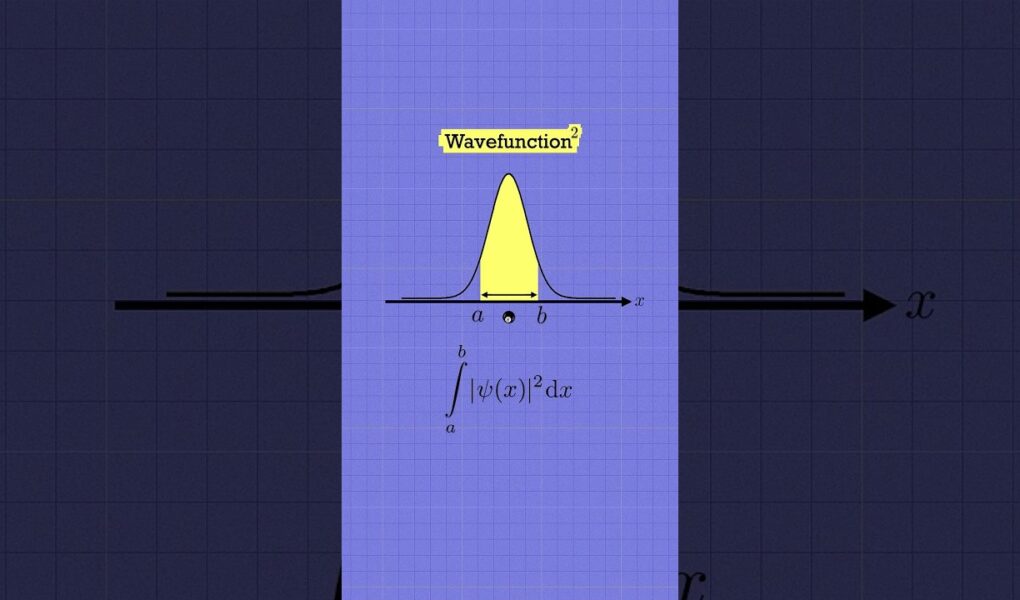
In quantum mechanics, a particle is described by its wavefunction, which assigns a complex number to each point in space. The square of the wavefunction tells us the probability of where we’ll find the particle when we go to make a measurement.
For more, find me @PhysicswithElliot or visit https://www.physicswithelliot.com
Source



The way this was explained makes it seem like it's possible that a particle has 99,999999…% probability being measured on earth and a 0,00…..001% probability that it's being measured at the edge of the observable universe 😂
it's called calculus…
…calculus for
squares (🎱) = (nerd**2 + geek**2)**1/2
Normalising what exactly🙂
How do make the animations like this …flipaclip?
And that's only a particle …
Dude
I know that I am a sinner and unworthy to proclaim the holy Gospel, yet:
Proclamation of the Gospel of our LORD JESUS CHRIST according to John:
-Glory to You, O Lord.
1 On the first day of the week, Mary Magdalene went to Jesus' tomb very early in the morning, while it was still dark, and saw that the stone had been removed from the tomb. 2 So she ran to find Simon Peter and the other disciple, the one whom Jesus loved, and said to them: "They have taken the Lord from the tomb, and we do not know where they have put him." 11 Mary stood outside the tomb, weeping. As she wept, she bent over and looked into the tomb. 12 She saw two angels dressed in white, sitting where Jesus' body had been laid, one at the head and the other at the feet. 13 The angels asked: "Woman, why are you weeping?" She answered: "They have taken my Lord, and I do not know where they have put him." 14 Having said this, Mary turned around and saw Jesus standing there. But she did not know that it was Jesus. 15 Jesus asked her: "Woman, why are you weeping? Whom are you looking for?" Thinking it was the gardener, Mary said: "Sir, if you were the one who took him away, tell me where you put him, and I will go and get him." 16 Then Jesus said: "Mary!" She turned and exclaimed in Hebrew: "Rabbouni" (which means: Teacher). 17 Jesus said: "Do not hold on to me. I have not yet ascended to the Father. But go and tell my brothers: I am ascending to my Father and your Father, my God and your God." 18 Then Mary Magdalene went to announce to the disciples: "I have seen the Lord!" and she told them what Jesus had said to her.
— The Word of the Lord.
— Glory to You, Lord Jesus.
"Brothers and sisters, today we celebrate the feast of Saint Mary Magdalene, the one who had the first encounter with the risen Jesus. And what is Mary Magdalene’s journey like?
Mary Magdalene: Between absence and encounter
Mary Magdalene’s journey in today’s Gospel leads her to a transformation. So, what do we see in the text? She moves from a feeling of absence—the absence of Jesus due to His death—to the experience of an encounter; from inner confusion—'Why have they taken my Lord?'—to mission, for she meets the Master.
She goes to the tomb while it is still dark. This reflects an inner state, symbolizing a kind of darkness. How often do we find ourselves in an inner darkness? We lose our understanding of God's will; we lose our spiritual and supernatural vision.
She sees angels but does not understand. Jesus appears, and she mistakes Him for the gardener. This teaches us that it is not always true when we say God is absent—it is not always the reality. Often, the issue is our own difficulty in recognizing Him.
Mary Magdalene’s heart loves, yet she does not yet understand what God is doing. So, brothers and sisters, what do we learn from this text on this feast of Saint Mary Magdalene? We learn that the Resurrection is not a return to the past, but an opening to the future. Faith cannot imprison God in memories or past experiences. The Risen One always leads us onward—always leads us forward and upward—and may this be true in our lives as well.
May the blessing of Almighty God—Father, Son, and Holy Spirit—descend upon you and remain with you always. Amen!"
—Father Edison Oliveira
huh?
The total area under Psi squared is 1. Does this mean, the area of the plotter probability graph is one since the probability is also 1
What a terrible video 😂
Basing the wave, I like it. Makes perfect sense when you put it that way. TY for this!
Probability
Why is it squared
(Explain it to me like I have education through calc BC but have forgotten most the material because it’s July)
When the desire to find the particle is eliminated by the smell of a fart, what will happen to the quantum timespace?
white people when there’s psi at the wavefunction
In the 60-second video actually learned what integrals are but I never really understood in school LOL
Very helpful.
the monists would live the idea
Richard Feinmann stated that anyone who says they understand quantum mechanics doesn’t understand quantum mechanics.
I have the frustrating feeling that I knew what most of these mathematical concepts was, and I have now forgotten because Calculus was many years ago
Very nice way of explanation of probability and density … Keep up .. brother
Its really simple if we know atleast 4 terms of what he spoke about
Negative to Positive infinity is the least measurable point in the complex plane which is the particle such that the probability that it is somewhere is unity or 1.0.
Isn’t it 0 when you specify the position according to Prob(x)? How can it be said that psi descibes the probablity find the particle at ‘that’ position?
Just remember, all probability is perception, the reality is just inaccessible, but strictly deterministic.
In HILBERT space – not in 3-D space
I don’t think that’s true.
is it weird that I uderstand it 1000% but dont know the math
You explained it so well bro….
Ha ha
This equation makes sense
Its te 4th solution of schrodinger equation which stated that a particle can never escape our universe❤❤
No, yeah, that's what i was gonna say.
Great ❤