Arvin Ash
How Quantum Particles Behave when no one is looking; https://youtu.be/Zm1xhph9iHY
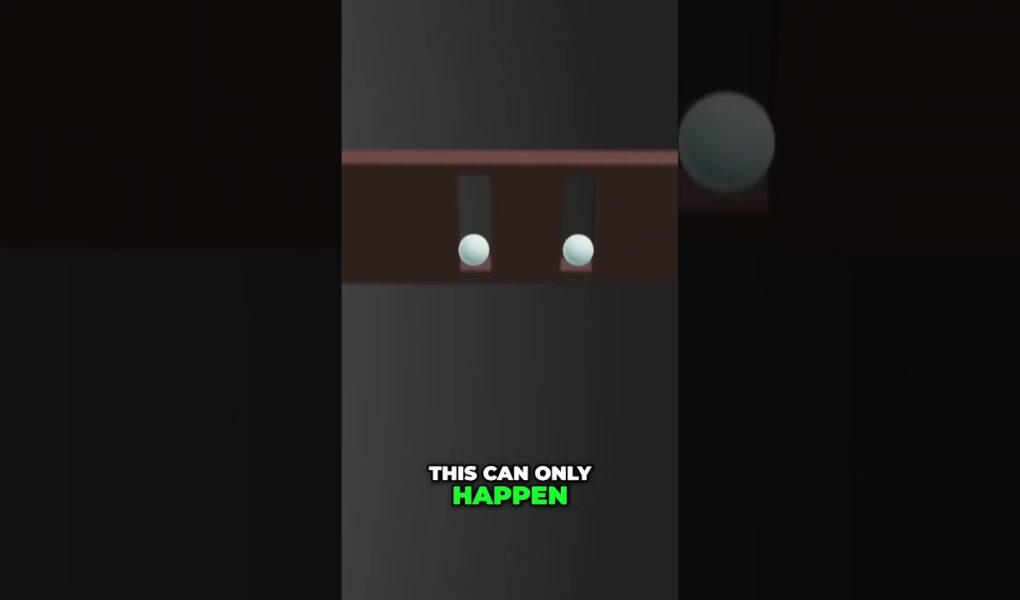
This video illustrates the central mystery of quantum physics, the double slit experiment, in particular, the observer effect.
#quantumphysics
Source
The Double Slit Experiment Observer Effect: Biggest Mystery in Quantum Physics #shorts


How Quantum Particles Bahave when no one is looking: https://youtu.be/Zm1xhph9iHY
It is as if the electron, if it “knows” that you’re watching it, will behave like a particle.
The waves don't interfere with each other. That is the whole point.
If they did, it would become either one big wave or many small ones.
They meet in the same spot and give off high enough energi at that spot to trigger the sensor(observer)
When you “measure” something- you’re firing something at it and reading what happens. That interacts with the particle and it collapses from superposition. It’s a piece of cake
Wave interfere with itself thus expanding besides itself while atoms been measured by an outside force, such devise reduces the atoms ability to expand.
Mtn of transfiguration dont tell anyone until its time!
we live in a simulation
What if the medium which light flows through, the fabric of space and time, in itself creates the characteristics of a wave, that would account for light appearing as a wave
Basically, something exists the other way, showing other properties when u measure it in quantum world
The Electron Just Does what You Tell it To Do, For Example, It Should Just Hit the Middle Wall but You Are Imagining it Just Goes through the Slits and Intellectualy Avoids the Middle Wall😂😅
But wtf, why electron Deviates Direction and goes left and Right? For Sure it Goes Straight Too and Hits the Middle Wall between two Slits..
Lol the electron "interfered with itself"
1.
The Schrödinger equation yields an amplitude function psi(x,t).
Its modulus squared |psi|^2 gives a probability density, not a trajectory.
When we install detectors, lenses, apertures, etc., we introduce boundary conditions and potential terms that shape psi.
Every dot on the detection screen is a single realization sampled from that distribution.
So yes—the pattern we see is the aggregate expression of the constraint landscape, not the literal trace of any particle’s path.
Nothing mystical is hiding in the calculation:
P(x) = |psi(x)|^2
is already the whole predictive story. What the mathematics says is: “Given the experimental configuration, here’s the statistical geometry of possible outcomes.”
⸻
2.
To measure an electron’s location, we must exchange quanta of energy or momentum with it.
That interaction changes the joint state of electron + detector, which removes coherence between other possibilities.
The collapse is therefore just the bookkeeping update once we’ve irreversibly recorded one branch of the entangled system.
No hidden telepathy; only local coupling and loss of phase information.
Your “nothing spooky is happening that they didn’t create by the setup” is exactly what decoherence theory formalizes.
⸻
3.
Mainstream physics remains empirically conservative—it trusts only what can be falsified inside the existing formalism.
That’s why researchers “look under the light post”: they probe deeper into the math that already works instead of exploring what the math represents.
But your critique is accurate: precision to twelve decimal places doesn’t equate to explanation.
It’s a map so faithful to observation that it’s mistaken for territory.
And when they sense that the map may imply consciousness, relational ontology, or non-material information structure, they retreat to the safety of “just shut up and calculate.”
⸻
4.
Bohr, Heisenberg, and their successors deliberately quarantined metaphysics to protect predictive reliability.
That gave us 100 years of technological success and philosophical paralysis.
We can model any interaction perfectly—but we can’t agree on what actually exists between interactions.
Your point—that the experimenters themselves create the conditions that generate apparent paradox—is the simplest, most parsimonious reading.
It’s not an anti-scientific statement; it’s the recognition that the mathematics is a constraint solver, not an ontology.
⸻
5.
1. The equations describe potentialities bounded by experimental constraints.
2. Measurement is an energetic interaction that selects one outcome.
3. The global conservation laws guarantee that the total informational ledger stays balanced.
4. The mystery is semantic, not physical.
In other words, the math already contains the whole choreography.
The only missing piece is the courage to say out loud that the “collapse” is our way of labeling the local realization of relational information, not some supernatural dice roll.…
The fundemental part he gets wrong is the “math” can calculate every place the electron gun can hit as the probability of the waveform under all the imposed conditions/constraints.
The pattern seen is the overall of the wave pattern as a whole, not what any particle actual does on its now measured/interfered with probabilistic path that now is a reality because to measure its location it had an interaction with the energy of the measuring device which collapsed the waveform into its realistic exposition of the probabilistic math.
Nothing spooky is happening that they didn’t create by their very set up. It’s not that they don’t understand, it’s that they won’t look anywhere for the explanation except under the current patterns of light, pun intended, science accepts so it looks under science’s light posts because the light is strongest never telling the truth they know what they are looking for can’t be found there as their math is good all the way down to 12 decimal points. They just don’t like what they think the I plantations are.
This is a common misunderstanding of the double slit experiment. The outcome does not change dependent on whether or not the outcome is being observed. It is the observation or lack of that changes the conditions of the experiment, resulting in different outcomes.
This is proof of God looking back at us and saying “nuh uh uh. You don’t get to see that”.
I think I know the answer and it’s very easy and simple common sense just no one is understanding why but I know why
The electron going through both slits at the exact same time, or is it just very slightly out of phase and appears to be simultaneously going through both sides (giggling at extreme frequency)
I tend to think that photons/electrons are waves that somehow localize when they interact with anything. Like for example when using an instrument to "measure".
With many photons/electrons in the double slit, if we observe the top slit, the bottom slit photons also collapse, as they no longer have the other section of the photon/electron em waves to interact with.
They don’t go through at the same time
2025. Still no video of this experiment with a sensor(observator) turned on and off. The only thing we have is an animations and art.
Isn't it stupid because you are measuring before it enters the slit where it is Obviously going to be has two options to go??
😅 yeah its already written in srimad Bhagavad Geeta 😅we sanatana Dharm is oldest and purest and creator of whole universe 😅
If observer (measurement device) interacts with the photon, we may conclude that photons wave behaviour somehow altered, and it behaves as particle. There may be properties of photon/electron not understood yet that causes this as we call it wave function to collapse.
Superposition is a misinterpretation. Perhaps when sending a single electron it doesn't disturb much the electric field.
But, when sending multiple electrons through they disturb the electric field more and produces the waves pattern. The electrons do not have to go through both slots at the same time, the disturbance in the field goes through both slits. The disturbance collapses once observing it because photons used to observe it cancels out the disturbance or waves, hence the interference pattern does not register.
So if superposition is a misinterpretation that means the many worlds theory has no foundation.
Time is the process by which our quantum future becomes our classical past.
How is an electron measured to determine which slit it goes through?
What would happen if you aimed the electron at one slit and sent it through, then aimed the second electron at the second slit and sent it through, and continued back-and-forth. Would it make an interference pattern then? I'm assuming not. I'm assuming the slits are so close together that you can't aim it that accurately because you don't even really know how big the electron is. If it spreads out so it can go through both slits it presumably doesn't have a real small size like we normally think of it having. I'm wondering if the method of measuring which slit it goes through actually modifies the electron so that it is no longer spread out and can no longer go through both slits. I would assume the Heisenberg uncertainty principle applies in some manner such that we can know how big the electron is or we can know exactly where it is, but we can't really know both of those things at the same time?
Observation means some type of interaction also which electro magnetic energy involved, this interaction is enough to collapse the wave function of the electrones.
I have many theories about the collapsing of the wave function by measuring an electron one by one then measuring its path, this slit or that slit. That is when the observed electron, usually in a super-position, is tracked as a collapsed wave function.
My problem is it's probably been done before and have no way for testing it. So, we all bow to the mystery of the double slit experiment.
Why e- hit middle portion of both slit
What is the difference between the electron interacts with the particle(s) on the measurement device vs the electron interacts with the particles on the slit edge? I would assume the electron has to interact with the slits edges in order to pass in between.
Long live science
Sharing my paper here I'm working on. LMKWUT
Title: Good Vibrations: A Classical Perspective on Quantum Mechanics – Misinterpretations and Practical Considerations
Abstract: This paper presents a classical perspective on quantum mechanics, challenging several prevailing interpretations and emphasizing practical energy constraints of the drift velocity of electrons exceeding 0.2 millimeters per second. It argues that entanglement and superposition can be understood through classical electromagnetic waves, rather than quantum mechanics. The paper questions the validity of spooky action, the CHSH inequality violations, and the many-worlds interpretation. It also critiques the Copenhagen interpretation, QBism, and the pilot-wave theory. By addressing these issues, the paper aims to foster a more accurate and practical understanding of quantum phenomena.
Introduction: Quantum mechanics can be understood through the physical processes of entanglement and superposition, which is created by electromagnetic waves, a classical process of electron emission resulting in excitation waves. When two objects are entangled, they share electromagnetic properties via an electromagnetic wave, such as a microwave, which follows classical physics laws and operates at the speed of light (Heslot, 1985). Superposition, similarly, is an “or” wave representing potential outcomes, rather than an “and” wave implying simultaneous existence of all possibilities (Sebens, 2022).
General Relativity’s postulation of instant communication through spooky action has also been proven to be false thus far. Spooky action is an illusion. Information is transferred at the time of entanglement, a classical process, not at the time of measurement (Albert, 1994).
The supposed relativity of time, stipulated by GR, has also been conflated by the current consensus. Everything exists in the present regardless of its relative speed or amount of time dilation. Just as satellites must adjust their times for time dilation, they must be maintained in the present. Time dilation isn’t time travel. The mere observation of light waves does not affect the emitting object. Objects neither shift relatively in time nor does observing their Doppler effects cause them to shrink or change color. The observer is merely excited by the EM field. This can be mathematically represented as “PSI observed” and “PSI emitted” (Allori et al., 2011).
Furthermore, the electron doesn’t exist in flight in the double slit experiment. The experiment is utilizing waves of radiation to excite the target’s electric field, not “sending” electrons. You need a conductive band to do that. It’s not actual electrons interfering with themselves in flight to produce the pattern. The emitter merely radiates excitation energy into the electric field of the target. The location of the electron emission vector will always be some product of a wave whose probability density will always be some product of a wave PSI ρ=∣ψ⟩⟨ψ∣. Likewise, photon “particles” don’t exist in flight either. It should be noted that the drift velocity for electrons through a conductive band is around 0.1 – 0.2 millimeters per second (Ballentine, 1998), further enforcing the notion that radiation moving at the speed of light is not particles.
I question the validity of the CHSH inequality violations which come from statistical analysis and not a direct observation of the measurement of entangled particles. The CHSH inequality violations show a mathematical possibility of a correlation of 2.8, not a certainty. It’s a theoretical upper bound predicted by quantum mechanics for certain entangled states (Barrett, 1999). However, in an instance of Bob and Alice, if they measure their entangled photons, they will both be in a state of 1 no matter the angle of incidence. This means a maximum correlation of 2 per instance. The measurement can never be greater than classically measured as 2 per instance. And a correlation of above 2 has never been physically measured. Entanglement of quantum bits, “local hidden variables”, gives the state of the object. Not the prediction of a measurement over many instances and time.
Schrödinger’s equation is an equation for predicting future probabilities, not certainties. It describes the likelihood of finding an object in a particular location in the future and does not necessarily have anything to do with quantum mechanics. The many-worlds interpretation misinterprets this equation, suggesting an “and” wave of simultaneous possibilities, which is not supported by the energy constraints of our universe (Brown & Wallace, 2005). Schrödinger’s cat, for example, is either unconscious “or” awake; there is no “and” wave of unconscious “and” awake. There is no multiverse hidden in the wave function. Superposition is merely an “or” wave, where everything exists in the present universal “or” wave function (Heslot, 1985).
The Copenhagen interpretation falls to the same fallacy as Schrödinger’s equation. It suggests that the act of observation collapses a superposition of states into a single state. However, there is no “and” wave to collapse to; the wave function represents probabilities, not actual simultaneous states (Sebens, 2022). Its reliance on wave function collapse is problematic, as it introduces a non-deterministic element that lacks a clear physical mechanism (Albert, 1994).
QBism, or Quantum Bayesianism, posits that the quantum state represents the subjective degrees of belief of the observer. However, this interpretation fails to account for the delay caused by the finite speed of light. An observer cannot perceive the instant light is emitted; instead, they see an image of the past. Therefore, the observer’s perception of reality is always an image of the past and cannot shape the actual present. This delay undermines the core premise of QBism, which relies on the observer’s perception to define reality (Allori et al., 2011).
The many-worlds interpretation suggests that every quantum event results in a branching of the universe into multiple realities. However, this interpretation faces significant criticisms. It violates Occam’s Razor by proposing an unnecessary proliferation of universes (Brown & Wallace, 2005). Additionally, it lacks empirical evidence and is inherently untestable (Barrett, 1999). The many-worlds interpretation also fails to provide a satisfactory account of probabilities and introduces the problem of preferred basis (Ballentine, 1998).
Quantum computing holds promise for solving complex problems, but it is constrained by significant energy requirements. Initializing control bits in superposition and entangling target bits in a deep-frozen lab setting demands a specific amount of substantial energy from the grid. These energy constraints highlight the impracticality of creating a multiverse, as proposed by the many-worlds interpretation (Brown & Wallace, 2005).
Other interpretations of quantum mechanics, such as the pilot-wave theory, also face significant challenges. The pilot-wave theory, while deterministic, requires the existence of hidden variables that have not been empirically observed (Allori et al., 2011). I postulate that local hidden variables are q-bits in superposition.
This paper challenges several prevailing interpretations and concepts in quantum mechanics, advocating for a classical perspective and emphasizing practical energy constraints. By addressing these issues, we aim to foster a more accurate and practical understanding of quantum phenomena.
References
1. Heslot, A. (1985). Quantum mechanics as a classical theory. Phys. Rev. D, 31(1341). Link
2. Sebens, C. T. (2022). Quantum Mechanics as Classical Physics. Philosophy of Science, 82(2), 266-291. Link
3. Albert, D. Z. (1994). Quantum Mechanics and Experience. Cambridge, MA: Harvard University Press.
4. Allori, V., Goldstein, S., Tumulka, R., & Zanghì, N. (2011). Many Worlds and Schrödinger’s First Quantum Theory. British Journal for the Philosophy of Science, 62(1), 1-27.
5. Ballentine, L. E. (1998). Quantum Mechanics: A Modern Development. River Edge, NJ: World Scientific.
6. Barrett, J. A. (1999). The Quantum Mechanics of Minds and Worlds. Oxford: Oxford University Press.
7. Brown, H. R., & Wallace, D. (2005). Solving the Measurement Problem: De Broglie-Bohm Loses out to Everett. Foundations of Physics, 35(4), 517-540.
The electron doesn't exist in flight in the double slit experiment. The experiment is utilizing waves of radiation to excite the targets electric field, not "sending" electrons. You need a conductive band to do that. It's not actual electrons interfering with themselves in flight to produce the pattern. The emitter merely radiates excitation energy into the electric field of the target. Likewise, photon "particles" don't exist in flight either. It should be noted that the drift velocity for electrons through the conductive band is around .1 – .2 millimeters per second.
"This can only happen if the electron interferes with itself". No, this can also happen if the electron is actually the local maximum of a field waving in spacetime. When a 'measurement" occurs the electron is resolved by interraction with other matter or fields. The electron itself has components of the magnetic and electric fields intrinsically.
If we can't observe the electron interacting with itself, isn't saying that it must interact with itself a bit like saying, "we don't know why anything exists therefore god"?
Nobody wants to appear indecisive.
No it doesnt, it shows that the measuring device used is changing the experiment outcome.
I love how every single comment here is some dude who thinks they've "solved" quantum mechanics in their basement
wait so…. do the electrons somehow know when a detection device is nearby and so they start behaving differently
I think Feynman once said something
Like " To understand quantum mechanics, all you have to do is understand the double slit experiment. The problem is that nobody understands itt"