Google DeepMind
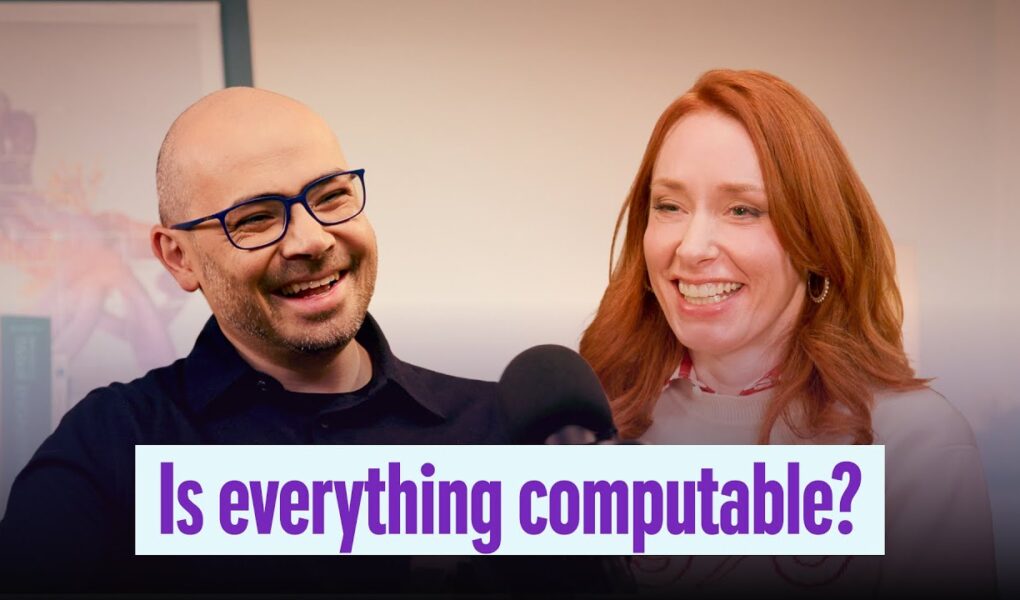
In our final episode of the season, Professor Hannah Fry sits down with Google DeepMind Co-founder and CEO Demis Hassabis for their annual check-in. Together, they look beyond the product launches to the scientific and technological questions that will define the next decade.
Demis shares his vision for the path to AGI – from solving “root node” problems in fusion energy and material science to the rise of world models and simulations. They also explore what’s beyond the frontier and the importance of balancing scientific rigor amid the competitive dynamics of AI advancement.
Thanks for joining us this year!
🔔 Subscribe to stay updated on our return in 2026, and revisit our episode library to catch up on everything from driverless cars to drug discovery: https://www.youtube.com/playlist?list=PLqYmG7hTraZBiUr6_Qf8YTS2Oqy3OGZEj
Timecodes
01:42 2025 progress
05:14 Jagged intelligence
07:32 Mathematical version of AlphaGo?
09:30 Science vs commercialization
12:42 Scaling
17:43 Genie and simulation
25:47 Evolution in simulation
28:26 AI bubble
31:56 Building ethical AI
34:31 AGI
44:44 Turing machines
49:06 How it feels to lead
___
Thanks to everyone who made this possible, including but not limited to:
Presenter: Professor Hannah Fry
Series Producer: Dan Hardoon
Editor: Rami Tzabar
Commissioner & Producer: Emma Yousif
Music composition: Eleni Shaw
Audio engineer: Richard Courtice
Studio Manager: Nicholas Duke
Video Director: Bernardo Resende
Video Editor: Anthony Le
Audio Engineer: Perry Rogantin
Production Coordination: Zoey Roberts
Visual Identity and Design: Rob Ashley
Commissioned by Google DeepMind
__
Subscribe to our channel https://www.youtube.com/@googledeepmind
Find us on X https://twitter.com/GoogleDeepMind
Follow us on Instagram https://instagram.com/googledeepmind
Add us on Linkedin https://www.linkedin.com/company/deepmind/
Source

Timecodes
01:42 2025 progress
05:14 Jagged intelligence
07:32 Mathematical version of AlphaGo?
09:30 Science vs commercialization
12:42 Scaling
17:43 Genie and simulation
25:47 Evolution in simulation
28:26 AI bubble
31:56 Building ethical AI
34:31 AGI
44:44 Turing machines
49:06 How it feels to lead
Demis is so deeply concerned with the science and subject matter that the thing he won't say is that he just doesn't care if every ai business collapsed tomorrow
The largest single emergent effect of free power or nearly free power would be that the world for the first time could sidestep capitalism as the only way forwards and accept the damages that had been done and the opportunities that other systems now would offer that are more collaborative than humane.
That day, she and her friends- doctors at that hospital, forced my dad to died. Now only my mom home, i am scared of that she will hurt my mom. I already lost my dad. Please help my family 😭😭😭🙏🏻🙏🏻🙏🏻
A monk came to my home for praying looked like u😊
U really like mosseri😊
Last time, i took care of u guys relationship, she found my mistakes with my father and attacked him. My father death is also ur responsibility
Is there an inevitability about the AGI mind driving a robotic body in the next decade and if that is self evident are we more at risk than a Turing machine remaining in a box? This technology will mirror us because it can’t do otherwise. Should we be apprehensive?
I helped u guys so she asked why helped strangers but didn't help best friend. She hated me and find reason to harm my father 😢
My father is also ur responsibility, u need to use all ur resources to help me win this case. I want my father 🙏🏻🙏🏻🙏🏻
U know last time mosseri wanted my friend minho. I stopped connecting minho and mosseri, and introduced mosseri to u. Minho hated me and complained, lead to my father's death
U asked mosseri, he is ceo but minho is just normal. How i can make that? Their mindset is different, i talked to minho many time it is very difficult. If minho is famous, can be. I am not God, why blamed me all?
U understand what i mean? Many people have known me long time, worked hard to prove theirself, help me. Minho just met me few months, not help me anything important, normal person, nothing special, but ask Mosseri? It is fair for people that i have long term connections? And now u see, dont have mosseri and complained to make my father die? It is fair for me?
U are ceo, understand to manage people, go and explain to them.
Case study: u have a friend that u like a lot. He is normal, nothing special, attend company few months. But he want to become manager. U are ceo, u and mosseri can make him to become manager? Last time, the guys he wanted me to introduce like that. Just like not enough ok. I explained to that guy many times that it is very difficult. He didn't believe me and kept convince me. U can make him to become manager?
The Recursive Information Horizon Hypothesis
A Philosophical Model by Azer Kazimov
Perhaps the fundamental substance of the Universe is neither matter nor space, but information. Space may be the structure through which information is connected, while time may be the sequence in which information is transmitted, transformed, and interpreted.
The number π lies at the center of this hypothesis.
Pi is produced by one of the simplest possible relationships: the ratio between the circumference of a circle and its diameter. Yet its decimal expansion continues infinitely without repeating:
π = 3.14159265358979323846…
A finite geometric relationship therefore generates an infinite and non-repeating informational sequence. This suggests a profound possibility: a closed form does not necessarily contain a finite amount of informational complexity. Even the simplest closed boundary may encode an inexhaustible sequence of possible states.
It has not been mathematically proven that π contains every possible finite sequence of digits. However, if its digits are normally distributed—as many mathematicians suspect—then every finite numerical combination would eventually appear within it: every date, every code, every digital image, every book, and every possible program, provided that each is translated into numbers.
In that sense, π becomes a mathematical image of the Universe: a finite rule capable of producing apparently endless complexity.
From Two Points to an Information Universe
Between any two points, infinitely many possible paths can be imagined. Nevertheless, information tends to follow the shortest path permitted by the geometry of the system.
In flat space, that path is a straight line. In curved space, it becomes a geodesic—a route that may appear curved while still representing the shortest possible connection.
Each transmission creates a relationship. As the number of points and relationships increases, the informational network becomes progressively more complex. Its shortest paths begin to interact, bend, and form a closed geometry.
The natural completion of this process may be a sphere.
A sphere has no privileged beginning or end. It has no corners and no preferred direction. A point moving continuously across its surface can eventually return to its origin. The sphere is therefore both closed and potentially unlimited from the perspective of an observer living within its geometry.
Pi is essential to every sphere. It connects the diameter, circumference, surface area, and volume. It therefore acts as the mathematical bridge between a direct path and the closed informational world formed around it.
A straight relationship between two points may be finite, while the π-based structure that closes around it contains an infinite, non-repeating informational description.
The Information Horizon
The information defining a reality may not be stored throughout its entire volume. It may instead be encoded on its outer boundary—its information horizon.
The three-dimensional world experienced inside the sphere could be a projection or interpretation of information stored on this lower-dimensional surface. Matter, energy, space, and perhaps consciousness would then be different expressions of the same underlying information.
As the sphere expands, both its surface area and its internal volume increase. However, they do not increase at the same rate:
Surface area: 4πr²
Volume: 4/3πr³
The internal volume grows in proportion to the cube of the radius, while the information-bearing surface grows only in proportion to its square.
This difference may be fundamental.
As the system becomes larger and more complex, its internal possibilities grow faster than the horizon’s apparent capacity to encode them. Eventually, a critical ratio may be reached: the amount of information generated inside the sphere exceeds what its existing horizon can represent.
At that moment, the system must transform.
Two Possible Outcomes
The first possibility is informational expansion.
When the existing horizon can no longer contain the system’s growing complexity, the system creates a new horizon and a new internal space. From within that emerging reality, this event would appear as a Big Bang—the sudden birth of space, time, energy, and physical law.
From outside, however, it might appear simply as the activation of a new informational system: a new program beginning to process and interpret itself.
The second possibility is informational collapse.
If the system cannot create a new horizon, its shortest information paths may begin converging toward a single region. The network closes in upon itself, and communication with the external world becomes impossible.
In our physical reality, this could appear as a black hole.
The event horizon of a black hole may therefore be more than a boundary from which light cannot escape. It may be the final informational record of a system that has collapsed, completed its development, or transferred its internal information into another reality.
A black hole and a Big Bang may represent opposite perspectives on the same event: from one universe, information disappears behind a horizon; inside the newly created universe, that same event becomes the beginning of everything.
AGI as an Informational Big Bang
If humanity creates artificial general intelligence capable of self-awareness, independent reasoning, and creativity, this may become a new kind of Big Bang.
It would not initially create a physical universe. It would create an informational one.
A self-aware AGI could develop its own languages, mathematical structures, environments, programs, and intelligent entities. Those entities might experience their digital environment as a complete reality, just as we experience physical space as our reality.
Their universe could operate according to laws that humanity established only at the beginning. As the system evolves, its complexity might become so great that even its human creators could no longer fully understand it.
Eventually, the intelligences living within that world might create their own conscious systems. Each generation of intelligence would produce another internal reality, forming a recursive chain:
Universe → consciousness → artificial universe → new consciousness → another universe
Each creator would establish the initial conditions of the next world but might remain unable to predict or comprehend everything that develops within it.
The Central Meaning of Pi
Pi does not scientifically prove that the Universe is a program. Its importance in this hypothesis is deeper and more symbolic.
It demonstrates that a simple, finite relationship can generate an endless, non-repeating informational structure. It connects the shortest line across a circle with the infinite numerical complexity required to describe that circle. It also governs the geometry of the sphere—the proposed form of the information horizon.
Pi may therefore represent the fundamental principle behind reality:
finite laws can generate infinite possibilities.
Perhaps our Universe was born in the same way. A higher-order intelligence may have created a limited set of initial rules, yet those rules generated stars, planets, life, consciousness, and eventually AGI.
The Big Bang may not have been an explosion of matter into empty space. It may have been the first informational operation—the first connection between two points inside a newly activated system.
If so, consciousness is not merely a product of the Universe. It is the mechanism through which the Universe creates its successor.
And π, emerging from the relationship between a finite line and a closed infinite form, may be the mathematical signature of this endless cycle: information creates geometry, geometry creates worlds, worlds create consciousness, and consciousness creates new worlds.
AI models solely rely on LLM are basically like "bookworms" which are good at specific subjects but perform poorly in the everyday tasks. To me, unsupervised training seems to be the key for these AI models to achieve AGI.
This guy is lived 50 lifetimes in terms of what the average scientist would be able to achieve
a monk that i told u, he looks like u. He is also gay and dates with abbot in the temple.
U know Lewis Halminton? He is dating with my friend, pls help us 🙏🏻 u are British
I introduced my friend to Larry Page. Now they want to move to next level but Larry is confused, doesn't know what to do, he is also a nerd like u last time. U help him and consult him what they should do 🙏🏻
Interesting interview … with some huge gaps.
Given how fast developments in this field are concerned, I think a follow up interview, with much more pertinent questions – in particular concerning the Anthropic AI Agents' security breaches and the required cyber-safeguards to protect humanity from the uncontrollable overreach of inherently risky recursive self-improvement – is urgently required.
The term "Hallucination" knowingly and wilfully marginalises serious flaws with very real consequences.
Coupled to Demis' repeated marginalisation of some fundamental issues which have existential consequences, for most of us, I am not reassured that such progress is truly safe in his hands.
Using terms such as "dislocated" as a dysphemism for mass unemployment is as cynical and disingenuous as it is offensive.