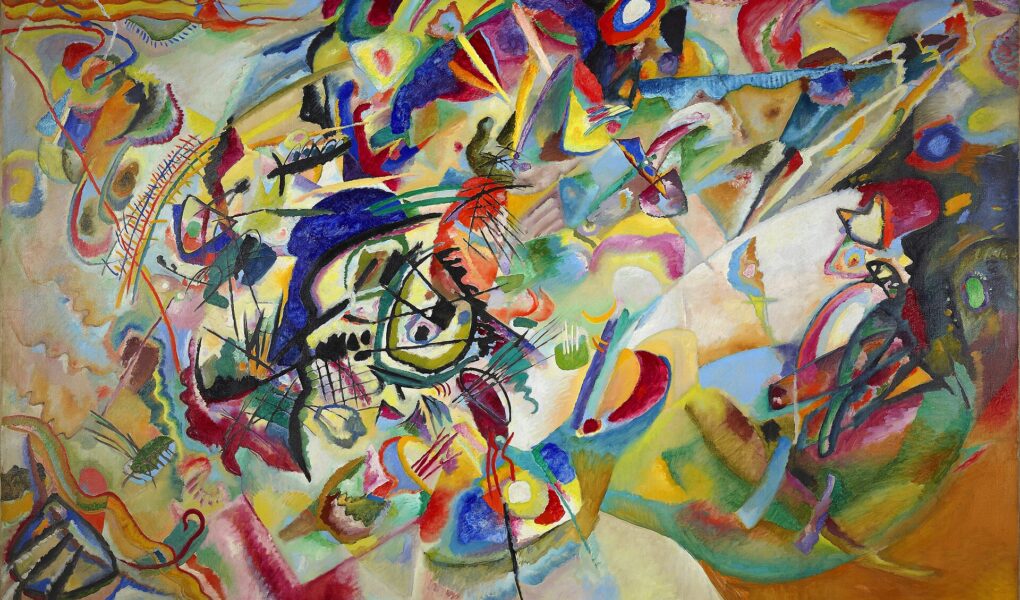
Stand in front of a large Kandinsky and something odd happens. There is nothing to recognise: no face, no landscape, no story. Just colours colliding, lines that swoop and stop, shapes that seem to float in front of or behind one another. And yet many people feel moved, unsettled or delighted. Why should a picture of nothing in particular do anything at all? For about thirty years, a field called neuroaesthetics has tried to answer that question by looking at the brain. It has learned some real things. It has also run into limits worth understanding.
Artists as neuroscientists
The British neurobiologist Semir Zeki, who spent his career studying the visual brain at University College London, is usually credited with launching the field. In his 1999 book Inner Vision: An Exploration of Art and the Brain, he made a provocative claim: that artists are, in a sense, neuroscientists. Without knowing any anatomy, they experiment with what the visual brain responds to, and they find out by trial and error.
Zeki’s favourite examples came from early abstraction. The visual cortex contains cells that respond selectively to lines at particular orientations, a discovery that helped win David Hubel and Torsten Wiesel a Nobel Prize. Zeki pointed out that painters such as Piet Mondrian and Kazimir Malevich, working with straight lines and blocks of pure colour, were reducing pictures to roughly the kinds of elements those early visual areas care most about. In his reading, they were not rejecting nature so much as stripping vision down to its building blocks.
Zeki’s lab later went looking for beauty itself. In a 2004 brain-imaging study with Hideaki Kawabata, people viewed paintings they had rated as beautiful, neutral or ugly. Viewing the beautiful ones was linked to activity in a region of the medial orbitofrontal cortex, an area also involved in reward and value.
Ramachandran’s “laws” of art
The same year as Inner Vision, the neuroscientist V. S. Ramachandran and the philosopher William Hirstein published an influential and deliberately bold paper, “The Science of Art,” in the Journal of Consciousness Studies. They proposed eight “laws” of artistic experience, principles that artists might use, consciously or not, to stimulate the visual brain.
The most famous is the peak shift effect, borrowed from animal learning. If a rat is rewarded for responding to a rectangle rather than a square, it will often respond even more strongly to a longer, more exaggerated rectangle. Ramachandran and Hirstein suggested that art works the same way: caricatures, stylised sculpture and exaggerated colour amplify what makes something distinctive, and the brain rewards the exaggeration. Other proposed laws included grouping (the pleasure of discovering which parts belong together), isolation (focusing attention on a single visual cue, as in a sparse line drawing) and the pleasure of perceptual problem solving.
These ideas are fun and often illuminating. But they deserve caveats. The laws were offered as hypotheses, not tested findings, and they fit some kinds of art much better than others. Peak shift is persuasive for a caricature, less so for a Mondrian grid. And the laws say little about why a work matters in its time and place, why fashions change, or why the same picture bores one person and moves another to tears.
Kandel and the reduction of art
The most sustained attempt to connect abstract art and the brain comes from Eric Kandel, who won a Nobel Prize for his work on the biology of memory. In Reductionism in Art and Brain Science: Bridging the Two Cultures (2016), he argued that science and abstract art share a method. A biologist studies memory in a sea slug because a simpler system reveals basic mechanisms. In the same way, painters of the New York School, such as Willem de Kooning, Jackson Pollock and Mark Rothko, reduced painting to elements like colour, line, gesture and light.
Kandel’s key move is about what the viewer does. Our brains handle images in two directions at once: “bottom-up” processing, which builds shapes and edges from what hits the eye, and “top-down” processing, which brings in memory, expectation and emotion. Figurative art gives the bottom-up system plenty to grab. Abstract art withholds it. With no obvious object to recognise, the viewer has to supply more from inside: associations, feelings, guesses. Kandel connects this to an older idea from art history, the “beholder’s share,” the part of a picture’s meaning that the viewer contributes.
Kandinsky and Mondrian: two kinds of abstraction
The two great pioneers of abstraction show how different that inner contribution can be.
Wassily Kandinsky, in his 1911 book Concerning the Spiritual in Art, compared painting to music. Colours had something like tones and moods; forms had something like rhythm. His large canvases from around 1913, such as Composition VII, seem to churn and explode, inviting the eye to move restlessly and the viewer to feel tension and release, much as one does with a symphony.
Piet Mondrian went the other way. By the 1920s he had limited himself to horizontal and vertical black lines, the three primary colours, and white and grey. His paintings look calm, even austere, but they are carefully unbalanced: a small block of red can hold its own against a large white field. Looking at one for a while, you start to feel the weights shift.
Neither artist was trying to show you a thing. Both were trying to show you seeing.
My take: abstract art as a mirror for perception
This is where the site’s own interest comes in. The usual question is “what does this abstract painting mean?” A more rewarding question, I think, is “what is my mind doing right now?”
Ordinary perception is so fast and so confident that we never notice it working. We see a chair, not a set of edges, shadows and guesses that the brain has assembled into a chair. Abstract art jams that process just enough to make it visible. You catch yourself grouping shapes, seeing depth where there is only a flat surface, feeling movement in a still image, reaching for a face in a cluster of marks and then letting it go. In that sense, an abstract painting is less a picture of something than an exercise in watching the mind construct what it sees.
That is also why neuroscience can only take us part of the way. It can show which brain systems are busy when we look at a Kandinsky, and it can explain why certain colours, contrasts and shapes grab attention. It cannot easily explain why one particular arrangement feels right, why a painting carries the weight of a historical moment, or why your response changes after you learn something about the artist. Studies of beauty in the brain also run into a stubborn fact: people disagree. The same image can be beautiful to one viewer and ugly to another, and brain activity tracks the personal judgement, not some fixed property of the picture.
So the honest summary is this. Neuroaesthetics has given us useful tools for understanding the ingredients of aesthetic experience: attention, reward, pattern-finding, the push and pull between what we see and what we expect. The experience itself, and its meaning, still belong to the person standing in front of the painting.
Further reading
- Inner Vision: An Exploration of Art and the Brain, Semir Zeki (1999)
- Reductionism in Art and Brain Science: Bridging the Two Cultures, Eric R. Kandel (2016)
- The Age of Insight, Eric R. Kandel (2012)
- The Aesthetic Brain: How We Evolved to Desire Beauty and Enjoy Art, Anjan Chatterjee (2014)
- Concerning the Spiritual in Art, Wassily Kandinsky (1911)