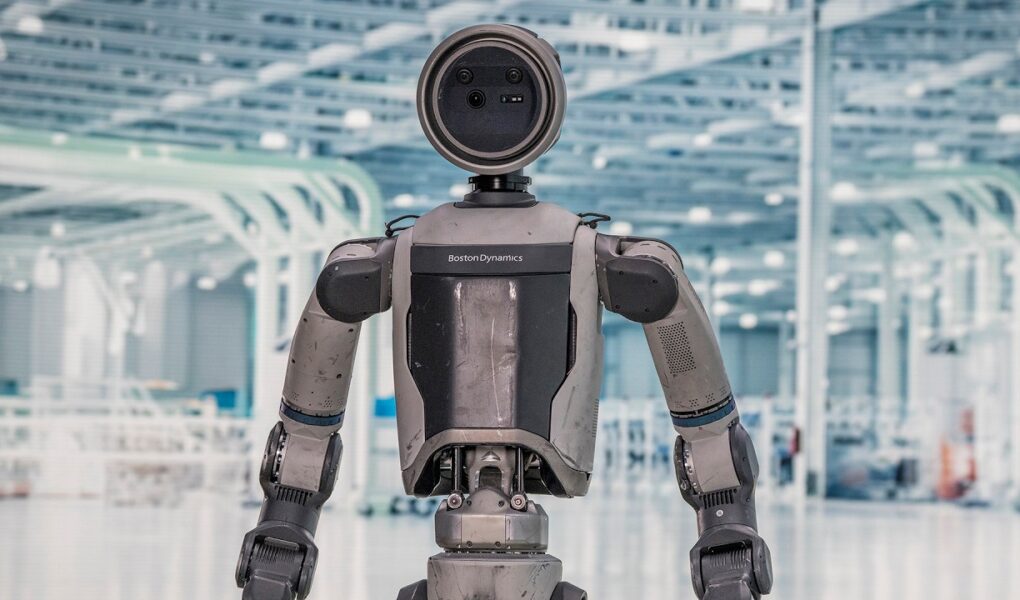
Boston Dynamics
Humanoid robots have long captured our imagination. Interest has skyrocketed along with the perception that robots are getting closer to taking on a wide range of labor-intensive tasks. What is driving this vision is not a preference for the human form but a recognition that humans are generalists—adaptable, quick to learn, and effortlessly retaskable.
This stands in contrast with decades of industrial automation, which have led to enormous gains in productivity by narrowing the scope of solutions to well-bounded tasks. However, designing systems that can scale economically to address the high diversity and stiff requirements of industrial labor tasks remains a significant open challenge.
In this discussion, we reflect on what we’ve learned by observing factory floors, and why we’ve grown convinced that chasing generalization in manipulation—both in hardware and behavior—isn’t just interesting, but necessary. We’ll discuss AI research threads we’re exploring at Boston Dynamics to push this mission forward, and highlight opportunities our field should collectively invest more in to turn the humanoid vision, and the reinvention of manufacturing, into a practical, economically viable product.
About the Presenters
Alberto Rodriguez
Director of Robot Behavior, Atlas
Alberto Rodriguez is the Director of Robot Behavior in the Atlas humanoid project at Boston Dynamics, where he leads teams working in controls, perception, planning, and machine learning behavior to bring the Atlas humanoid to scale. Alberto enjoys working at the intersection of hardware and software to build robots with physical intelligence. Before joining Boston Dynamics, he was a faculty member at the Mechanical Engineering Department at MIT and Director of the MCube Lab.
Aya Durbin
Product Lead, Humanoid Applications
Aya Durbin is a product leader recognized for transforming complex robotic technologies into intuitive, high-impact products that solve real-world problems. With a career spanning the evolution of automation and humanoid systems, she has built a reputation for bridging the gap between cutting-edge engineering and customer value. At 6 River Systems, Aya led the product vision for warehouse automation solutions that redefined efficiency in the logistics industry. Following the company’s acquisition by Shopify, she designed and deliver scalable fulfillment products supporting over 100 warehouses across North America and Europe. Now at Boston Dynamics, Aya leads the Atlas application strategy, shaping how humanoid robots can seamlessly integrate into human environments and bring meaningful value to people’s everyday work.
#BostonDynamics #Atlas #Manufacturing
Source
No dude, humanoids are the least efficient way to do robotics.
We invented the wheel just so you could be like "what if it could fall over like a drunk person"
What will people do for jobs then?
No sick days – accurately follows an instruction set every time – does not complain – can be upgraded – cheaper than humans ….humans are cooked
Cool but I hope Tesla will absolutely annihilate BD with their Optimus bot.
Sorry, legs don't make sense.
So the real question. What jobs/careers will be safe?. Why go to uni or even trade schools to study a soon to be defunct/obsolete career paths. Were probably at least a good 30 yrs away from decent mainstream bots walking around en masse. But How long till the rise of a B1-66ER?. Once these fools get their way, Construction of their own demise. (Skeletons clapping).
Unfettered science/progress is a recipe for disaster. Hubris is all I'm saying. Cliche saying, "they realised they could but never stopped to ask them selves if they should." Let's hope it never gets to that extreme. & If so they've thought of manual failsafes/overrides & backups, if the extreme should ever happen. Never say never, be prepared for the worst. Don't act shocked if it happens.
"Why we're replacing the human workforce and dont care if it destroys civilization when no one will have jobs anymore."
"Why Humanoids Are the Future of Manufacturing" – Because if they aren't, then BD are fucked.
Buh bye jobs.
Why don't you get Schunk hands, they are already done.
(that moment when you realize a hopeful science industry you've followed for years is only doing it to displace human labor instead of decreasing the responsibilities of hard factory jobs)
Ultimately all these robots are being produced by people, from parts produced by people. The robots will require constant maintenance from human beings.
So by replacing people you save on wages, but increase your overheads. You're also locked into a vendor-specific ecosystem so your company will be less independent.
Effectively what happens is that production becomes centralised even further, the investment becomes higher and the amount of profit required to keep running increases.
This will be catastrophic for the economy, GDP will go up though
In the coming future, ur best n ultimate customers will be NASA, mark my words. You should start listening to their opinion.
The future of anything is decided by the rich. So, my future doesn't even exist anymore
loserrrrrrr
Noooooo. Not the podcasts 🙁
Can't wait to loose my job to this
I wonder where people are going to get the money to consume… once you've automated away everyone's jobs
The future belongs to mechanoids. See what robots Chile presented. Incidentally, the Xpeng Iron robot was also developed by them.
Don't insult the robots by calling them humanoids
i love humandroids!
Humanoids are the future of robots because they can replace human workers….
Why aren't you excited?
Glad I have a shop that will never be able to have that garbage take over what I do.
Keep it up, and you'll be out of work.
BD's competitors are building out capability for mass production of humanoids, without having first solved most of the problems discussed here. They presumably are depending on public fascination to find a place for their initial offerings as household "pets". Deployment in large numbers serves a strategy of acquiring training data, just as Tesla uses telemetry from its millions of cars for developing self-driving. BD isn't doing this. Are they thereby fated to fall behind and lose out?
Of course, humans always evolved to live easier
Anyone who knows anything about humanoid robotics knows that humanoid robotics are only good for one thing: bringing in investor money. It's why Honda stopped working on the Asimo nearly a decade ago: it's a money pit. Maybe in 30-40 years when AI actually gets good it can be useful, but not today.
There are roughly 20 companies working on humanoid robots. None of them have even a tentative release decade or market they're targeting. All of them have been miserable failures in any scenario that isn't pre-prepared (including BD's).
The economics also don't work. If you assume that the average skilled factory worker costs you $75,000 a year (which is actually a gross overestimation since the number is actually closer to $30-50K). If you assume that each robot works as much as 1.5 people (to account for charging and breakdowns and the need for spares), and a 3 year "break even" cost is desired (meaning that after 3 years the robots are cheaper than a human), that means that AT MOST these robots would be able to cost $about $330K. At that price point, Boston Dynamics would need to sell about 14,000 units to break even to their 2024 budget.
But the fact of the matter is that they've only sold maybe 2000 units total over the last 5 years (sold at $75K). That's an impressive $150M in sales, which averages out to $30M/year. A drop in the bucket for a company that spends double that per year on R&D.
What a monster of a wooden table
❤❤❤❤❤❤❤❤❤
Thank you for not having music playing while they were talking
28:38 oh NO you gave Atlas the Hockey stick?!!!
How will proprietary training data be handled? Does that data get sent back to BD or does the end user retain that data?
Напишу "бесплатно" коментарий – возможно женщина "привлекательна", но если Вы "одели" на неë мужскую одежду, и по Вашему мнению это ей дало некую значмость, то ошибаетесь – скоро Вы про**ëте и этот "проект" …
I respectfully disagree, crabified robots are clearly superior in every way, but ya'll ain't ready for that discussion yet.
Delightfully candid and informative. You provided a much needed perspective that debunks the hype and phantasmagorical expectations coming from others players in this field, especially Musk.
Robots should be taxed to support human job losses.
Mass unemployment yayyy!! civil unrest wheee!!!! good job guys!
Really 😢I'm really sad for the future because more people looses their job soon.
I dig the interviewer's questions. Though driven by corporate interests, they were still very useful and insightful, as the asnwers were.
they're framing humanoid robots as the future while casually admitting humans will just be retaskable labor… this is literally what 12 Last Steps describes as corporations optimizing us into obsolescence while calling it progress
they're framing humanoid robots as the future while casually admitting humans will just be retaskable labor… this is literally what 12 Last Steps describes as corporations optimizing us into obsolescence while calling it progress
they're framing humanoid robots as the future while casually admitting humans will just be retaskable labor… this is literally what 12 Last Steps describes as corporations optimizing us into obsolescence while calling it progress
they're framing humanoid robots as the future while casually admitting humans will just be retaskable labor… this is literally what 12 Last Steps describes as corporations optimizing us into obsolescence while calling it progress
they're framing humanoid robots as the future while casually admitting humans will just be retaskable labor… this is literally what 12 Last Steps describes as corporations optimizing us into obsolescence while calling it progress
they're framing humanoid robots as the future while casually admitting humans will just be retaskable labor… this is literally what 12 Last Steps describes as corporations optimizing us into obsolescence while calling it progress
they're framing humanoid robots as the future while casually admitting humans will just be retaskable labor… this is literally what 12 Last Steps describes as corporations optimizing us into obsolescence while calling it progress