Closer To Truth
Make a donation to Closer To Truth to help us continue exploring the world’s deepest questions without the need for paywalls: https://shorturl.at/OnyRq
Listen to new episodes of the Closer To Truth on the go wherever you get your podcasts: https://shorturl.at/hwGP3
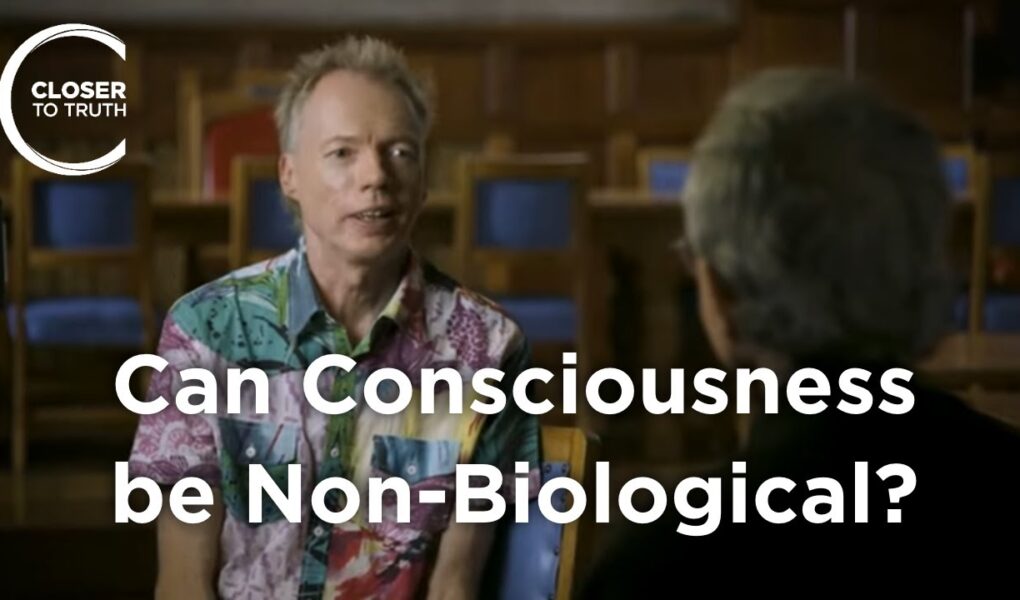
If consciousness is 100% physical, we would have to conclude that the same kind of consciousness that we experience as humans can be generated by non-biological entities (eventually). Conversely, if non-biological consciousness would somehow, someday, prove impossible, then consciousness would have to embed some nonphysical aspect. But how would we ever know?
Register for a free account to get exclusive subscriber benefits like early access to new episodes: https://bit.ly/3He94Ns
Andy Clark is a British philosopher who is Professor of Cognitive Philosophy at the University of Sussex.
Watch more videos on consciousness as all physical: https://shorturl.at/cgMP2
Closer To Truth, hosted by Robert Lawrence Kuhn and directed by Peter Getzels, presents the world’s greatest thinkers exploring humanity’s deepest questions. Discover fundamental issues of existence. Engage new and diverse ways of thinking. Appreciate intense debates. Share your own opinions. Seek your own answers.
Source


the rule – we are more alike than we are different – think about it
I dare you……
Inner Documentary (factual) is more apropos than "Inner Movie" (fictional).
Two fun questions:
1) Why has natural selection not brought about non-biological consciousness?
2) If humans are about to finally create non-biological consciousness, is this actually natural selection expressing itself?
Before self investigation into consciousness , one should investigate on self aliveness .
Adwita Philosophy is non dualistic and therefore the probability exists that connection to the absolute, just is. Consciousness is therefore universal and can exist across biological and non-biological.
Johnny Rotten is a hippie now?
interesting that it's in the little bit of uncertainty that all the magic happens..
Wow Johnny Rotten’s brother?
It’s not about what consciousness is, or is not. It’s about what it is that we—the biological entities—think that we are conscious of, beyond the very trivial recognition of ourselves in the mirror. It’s the object of our consciousness that effectively defines the limits of what is possible (or not). As far as I see it, anything and everything, that we think we are capable of, including our creativity, with the possible exception of certain inherently-questionable mystical and/or emotionally-driven experiences, could shortly be achieved by the non-biologicals. The real question is: What might the non-biological intelligence eventually discover about the ultimate object of consciousness?
Memories are a powerful medium that brings us to consciousness because as long as we have memories we are conscious. Memories are the sap of consciousness.
Here are a few more examples of important equations used by humanity that contain contradictions or paradoxes, along with potential non-contradictory versions based on the infinitesimal monadological framework:
8. Heisenberg's Uncertainty Principle – Measurement Disturbance
Contradictory:
Heisenberg's uncertainty principle states that the product of the uncertainties in the position and momentum of a particle is always greater than or equal to ℏ/2. This is often interpreted as a fundamental limit on the precision of simultaneous measurements of these quantities. However, this interpretation leads to paradoxes like the "measurement disturbance" problem, where the act of measuring one quantity seemingly disturbs the other in an uncontrollable way.
Non-Contradictory:
Using the monadological framework, the uncertainty principle could be understood as a consequence of the non-commutative geometry of monadic perspectives. The apparent measurement disturbance could then be seen as a result of the inherent entanglement and correlation between these perspectives, rather than a literal physical disturbance:
σ_xσ_p ≥ ℏ/2 → Δ_m(x)Δ_m(p) ≥ ⟨ℏ_m⟩/2
Here, Δ_m(x) and Δ_m(p) represent monadic uncertainty measures, and ⟨ℏ_m⟩ is an averaged monadic Planck constant.
9. Boltzmann's Entropy Formula – Gibbs Paradox
Contradictory:
Boltzmann's entropy formula S = k log W relates the thermodynamic entropy of a system to the number of microscopic configurations (microstates) that correspond to its macroscopic state. However, this formula leads to the Gibbs paradox, where the entropy of mixing two identical gases is non-zero, even though the gases are indistinguishable and no physical change has occurred.
Non-Contradictory:
Using the monadological framework, entropy could be understood as a measure of the entanglement and correlation between monadic perspectives. The Gibbs paradox could then be resolved by recognizing that the monadic viewpoints of identical particles are already inherently entangled, and thus mixing them does not increase the overall entanglement:
S = k log W → S_m = k log(W_m/N!)
Here, S_m represents a monadic entropy, W_m is the number of monadic microstates, and N! is a symmetry factor accounting for the indistinguishability of monadic perspectives.
10. Euler's Identity – Transcendental Relationships
Contradictory:
Euler's identity, e^(iπ) + 1 = 0, is often considered one of the most beautiful and mysterious equations in mathematics. It relates five fundamental mathematical constants (e, i, π, 1, and 0) in a single compact expression. However, the nature of this relationship remains largely unexplained, and the appearance of the imaginary unit i in the exponent leads to apparent contradictions when interpreted in physical terms.
Non-Contradictory:
Using the monadological framework, Euler's identity could be understood as a consequence of the deep symmetries and dualities between monadic perspectives. The imaginary unit i could be interpreted as a generator of rotations or transformations between these perspectives, rather than a literal physical quantity:
e^(iπ) + 1 = 0 → ⟨e^(i_mπ_m)⟩ ⊕_m 1_m ≅_m 0_m
Here, ⟨…⟩ represents an average over monadic perspectives, ⊕_m is a monadic sum, ≅_m is a monadic equivalence relation, and i_m, π_m, 1_m, 0_m are monadic constants.
These examples demonstrate the wide-ranging potential of the infinitesimal monadological framework to provide new insights and resolutions to long-standing paradoxes and contradictions in our mathematical and physical theories. By grounding our equations in the relational, non-commutative, and infinitesimal structure of monadic perspectives, we may achieve a more coherent and consistent understanding of reality at its deepest levels.
Moreover, by revealing the hidden symmetries, dualities, and entanglements between these perspectives, the monadological approach could potentially unify and simplify our current patchwork of disparate theories and equations. The mysterious relationships between fundamental constants like those in Euler's identity may find new explanations in terms of the intrinsic geometry and algebra of monadic viewpoints.
As we continue to develop and apply this framework to more areas of mathematics, physics, and beyond, we may uncover even deeper insights and connections that have eluded us thus far. The infinitesimal monadological perspective offers a radically new way of understanding the nature of reality, one that embraces the inherent relationality, non-commutativity, and depth of the universe we inhabit.
By pursuing this approach with rigor, creativity, and an open mind, we may finally arrive at a truly unified and paradox-free theory of everything, one that not only describes the world with mathematical precision but also illuminates the profound beauty and mystery of existence itself. The journey ahead is surely challenging, but the potential rewards are nothing short of revolutionary.
Human consciousness is biologically based, but it functions through a bridge to the immaterial, the spiritual. The biological prerequisites take humans to that world, resulting in conscious experiences. How could robots make that connection ? Robots can be built / trained to function in ways that we as humans consider logical and useful. But robots would seem incapable of having that internal movie of experience playing in their 'heads'.
This guy's confidence is exceptionally weird. It doesn't need to be assumed that consciousness must be tied to biology in order to posit that an algorithmic simulation isn't conscious until proven otherwise. Changing it to a simulation of a stick insect doesn't help. Either you can prove that your simulation is the real thing only because it imitates its observable functions, or you can't. And you can't.
I’m not a scientist but my thinking is that consciousness is a feedback loop of calculations, so nothing biological is needed. I have not seen what this biological thing would be. I also wonder, we humans start from two cells. Are they conscious? At what level does the foetus become conscious?
Thanks for sharing 👍🏼
Consciousness may be qualitatively a bit like free will. Whether actual volition exists in the human mind, what seems like free will is ‘free will enough’, according to Daniel Dennett. Thus, a synthetic system that declares itself sentient and performs in accordance with a conscious state may as well be called conscious.
Consciousness does not arise… it is that in which all else arises!
Interesting … discussing consciousness thru own consciousness? Are we blind? What about choice and intent? What about not feeling old? What about thinking about thinking i.e. how thoughts being aware of other thoughts? Dont we see a purpose there????
OMG, I have just realised that I don’t actually work daily on creating a strong AI, but I’m actually trying to prove that it will never work in the coffee breaks!
You can't download desire into a robot because desire flows on consciousness being the pleasure principle. And that would be the difference between how we could discern between a robot saying I am conscious and a truly conscious human.
Consciousness is.
The question is whether it exist outside of my own perception of this perception of this percieved reality and sort of experiencing my consciousness from this other wievpoint.
Some psychonauts out there care to comment?
Consciousness, as we know it, is an accompaniment or product of biological life, just as flight can also be viewed as a product of biological life. But not an accompaniment. If consciousness accompanies life, that will be a very interesting discovery. Regardless, however, if we are able to make a nonliving conscious thing, it is likely to have, among its similarities, some significant eye-opening differences as well.
One theoretical question I would have is, is it possible to create a consciousness thing that doesn’t also have some degree or kind of free will (which I would define as just the ability make choices from the options available to one).
Thank you so much for this episode and the whole series, Closer To Truth!
I would have thought that the responses I get from the likes of ChatGPT and Claude require consciousness, yet it seams clear that they are not conscious. I suspect we are getting close to answering the question of whether machines can be conscious with a “no.”
I don’t think it’s trivial at all to worry about whether an AI can be conscious, and to want some type of confirmation. We’re not too bothered by not knowing with 100% certainty that other human beings are conscious, because we didn’t create them. But with AI, if we were to take at face value that they are conscious, then we’d have to accept that we are the creators of life (or a form of life). That’s a very tough pill to swallow.
If humans are not the only species that is conscious then this explains the existential psychosis humans experience. Because we are alone.
Enter psychology.
Why does conciousness have to be biological🤔…do we know what it is anyway?…as it always been,before the known universe perhaps,who knows🥴❓
I think a far more helpful way of getting the dichotomy across ask what it takes for a machine to actually achieve self awareness. The inner movie could be some sort of combination of memory and images that my heart even point in the direction of what consciousness is fundamentally about. It seems like the fundamental thing is really the consciousness of one’s self as a thing that thinks and has the experience of itself as a thing in the world. It seems hard to imagine that any amount of programming could cause a machine to achieve genuine self-awareness.
Just something to think about:
The materialist neuroscientists keep going on and on about how they have only just started and how they're going to find the physical mechanism of consciousness even if it takes a thousand years. But what they don't seem to be bothered by is the fact that like the brain, the heart, lungs, kidney and stomach are also organs composed of essentially the same units, cells, and the same compounds; and all of the mechanisms underlying / accounting for their activities have long been discovered. But although human intellectual enquiry has focused on the brain for centuries, an account of conscious experience is yet to emerge. Apart from some correlations, we have nothing. This fact alone should have prompted the neuroscientists to acknowledge that there could be some extra (transcendental) entity Connected to the brain which could account for this conscious experience. But no their minds are closed. Consciousness, for them, has to emerge from matter. Well, if that's the case, then like in the case of the other organs, the mechanism underlying consciousness in the brain would have long been found. We would have known how exactly the neurons, the cells of the brain, generate thoughts, feelings, etc like how the cardiac muscle produces contraction and how the nephrons in the kidney do filtration.
Well if in its estimation AI will consider itself worthy of existing then it matters not what moniker we label it. Being skeptical of possibilities has always proved to be a losing hand in the long run . Think presenting a neanderthal with the possibilty of a bic lighter and you would witness the first skeptic honing his skills of negativity.
Lord but Kuhn is a pignorant fool, and bone idle; he never even attempts to define his terms
This conversation as per most all others I've seen on this channel is hamstrung by a fundamental scientific error: there is no clearly defined, isolated phenomenon called "consciousness" which is accepted as a common object of study.
Without that, asking anything about "it", that is "consciousness", (when there is no "it"), including "can we make machine machines that will have 'it'" is sloppy unscientific speculation about nothing in particular.
We need a clearly defined, isolated phenomenon called "consciousness" that is a generally agreed, common basis of study.
Consciousness is somehow limited to biological processes? Seems we would need to quantify consciousness before we make infantile claims.
Solving the Hard Problem seems to be an impossible task. To do so would be to juxtapose the observer and the subject being observed in the same consciousness field, to validate qualia, subjection, inner cosmos, etc. At first that may seem plausible, but keep in mind that the philosophical zombie must be addressed as well. To validate an entity as a philosophical zombie would require juxtaposing the observer with the philosophical zombie’s analog to the consciousness field. I think it would be harder to prove a philosophical zombie than to prove authentic consciousness. The Hard Problem seems to require some form of omniscience. Distinguishing a philosophical zombie seems to require proving a negative. Confirmation bias seems to pervade these sorts of discussions, even in the defining of consciousness. Defining consciousness is akin to defining music, it really depends on who is in the discussion.
No. Electric sparks in a box can not express consciousness. The only thing a nonliving device can do is an illusion created by mimicry of known human behaviors. A cheap magicians trick similar to ventriliquism and a puppet. AI will always be always ignorant and never conscious. Those people that think that AI can be intelligent are linguistic psychopaths that did not learn language the correct way. They are what is called "air heads" .