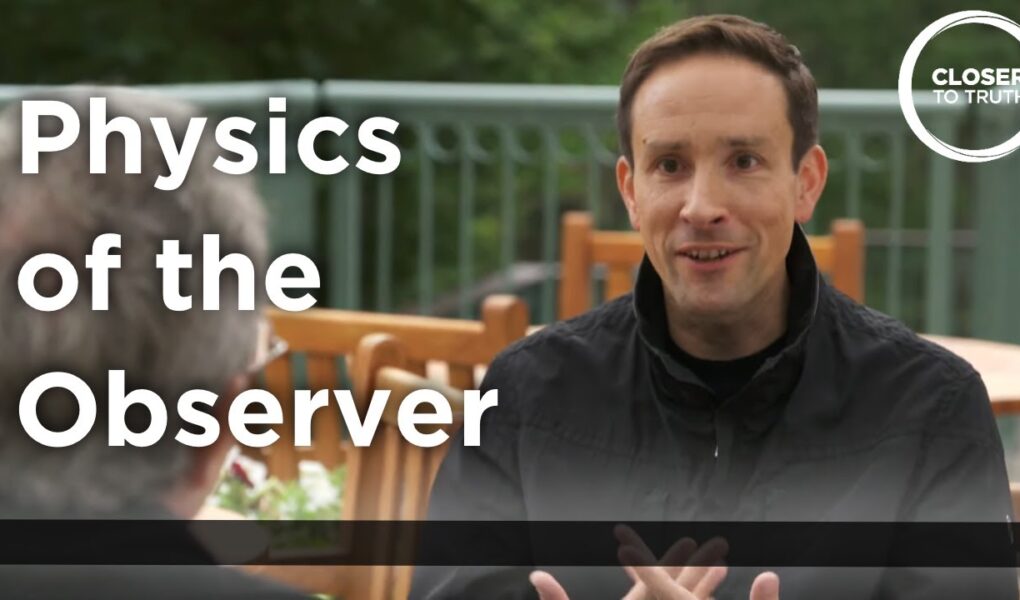
Closer To Truth
Does the concept of observation have deep relevance in fundamental physics? What about in quantum physics where some kind of observation seems to be needed to transform “wave function” probabilities into actual events? What’s an “observation” anyway? What does it take to be an “observer”? Must it have some kind of sentience?
Make a donation to Closer To Truth to help us continue exploring the world’s deepest questions without the need for paywalls: https://shorturl.at/OnyRq
Free access to Closer to Truth’s library of 5,000 videos: http://bit.ly/376lkKN
Watch more interviews on quantum theory: https://bit.ly/3skVMtE
Support the show with Closer To Truth merchandise: https://bit.ly/3P2ogje
Raphael Bousso is a theoretical physicist and string theorist. He is a professor at Department of Physics, UC Berkeley. He is known for the proposal of Bousso’s holographic bound, also known as the covariant entropy bound.
Register for free at CTT.com for subscriber-only exclusives: https://bit.ly/3He94Ns
Closer To Truth, hosted by Robert Lawrence Kuhn and directed by Peter Getzels, presents the world’s greatest thinkers exploring humanity’s deepest questions. Discover fundamental issues of existence. Engage new and diverse ways of thinking. Appreciate intense debates. Share your own opinions. Seek your own answers.
Source


Word salad for not knowing. A simple I don't know is all that's necessary
This is a much better setting for a discussion than in an art museum right smack in the middle of people trying to enjoy the artworks 😂
Knowing every particle still wont make you know the future, the chicken at the farm.
electromagnetic field energy measures particle(s) from quantum energy probability, expanding space in the process?
Professor Bousso seems to explicitly say total observation / measurement would result in complete determinism of events and also that it would result in nothing ever happening. So… those are not the same thing. Is this some ambivalence that's built into the nature of the problem or can't he make up his mind?
Also, talking about what 'we' observe as if wave function collapse is numerically the same for all observers was a notion that just slid into the conversation without being introduced as a problem. IDK what's happening in this conversation.
Beyond the human mind? Seriously? Then physics is going for dogma. We'll prepare for a new type of religion.
Look easier way to understand what QMECH is imagine a circle 360 ° each degree has 360 degrees now everything around us is energy now different path combines different degree to make a sum = whole now different paths equal different =whole ie properties the universe is everything we just don't see correct combinations yet
Talk without clarity.
https://youtu.be/pWnUCN7c8eQ?si=GmJjelgVITyA0Hfg
Awareness is known by awareness alone.
Seems to me to be the exact opposite that in fact, the measurable states are what we determine as being “deterministic” meaning it’s the path integral, I.e the measurable state that we can observe. The randomness and fluctuations are simply the probabilities that give reality a fuzzy boundary and is unknowable, since that is the true randomness of the universe. This is how the universe can both be random and deterministic.
Now, let's hear from analytical idealism people on the subject.
If there would be no live or consciousness in the universe then would the universe exist? Does the universe exist if no consciousness is in it to observe or explore it? If the answer is yes then what is the difference between existing universe or none existing universe? Maybe the universe is only real in the mind of the observer. That is all there is.
He set a lot in the interview yet he didn't answer the question of what makes an observer important.
This reminds me of his paper called "Dynamics and Observer-Dependence of Holographic Screens" that he published a little while ago.
The observer is consciousness.
6:02 RB “Nobody … tracks all the particles [and] light … that interact with a system [since] that would be impossible. [Yet] no one has [a] consistent theory [of] what [happens] when we don't keep track. … It is … irritating and disconcerting that what happens in nature might depend on how we draw that line. … A few years ago, Lenny Susskind and I [sought] a more objective way [to] divide the universe into [the seen and unseen by] drawing on … black holes [studies.]”
There’s no need for black holes, Professor Bousso. You answered your question: It’s impossible to track every particle in a system classically. But why is that? It’s because the energy cost of observation — of knowing where the parts of some system reside at a moment of observer time — stays very low for a vast range of low-to-medium-high nosiness, but quickly shoots to infinity if you get too nosy.
Where’s the plane? Radar says “Here!” The passengers don't even notice. Where are the hands of their retro-mechanical watches? A brilliant flash of visible light says “Here!” This time the passengers notice but survive. Where are the electrons in every orbital of every atom in the plane? The most intense burst of extreme gamma radiation in the history of the universe says “Here!”, but also vaporizes not just the plane, but the Earth and solar system, including the sun down to its core.
It’s the extraordinary width of that nosy-is-okay safe zone — a zone also known as classical physics — that fools us into thinking the arc of a thrown baseball is a “good” model for electrons around atoms.
It isn’t. No matter what our classically wired brains and classically inspired math models tickle us into believing abstractly, electron orbitals exist only in the absence of intense observation. They do not become “point-like” unless they are horrendously disturbed by energies far above range in which they exhibit valuable properties such as volume (being part of a black hole is so boring) and chemistry.
So, where should humans set the line between the seen and unseen?
The answer is that this is the wrong question. We don’t set that line. It’s the sea of not-too-cold, not-too-hot self-observation energies provided by thermodynamics that sets the line for us. Especially in the case of warm, Earth-like planetary surfaces, thermodynamics enables just the right mix of stable wave-like phenomena (e.g., orbitals) and emergent “tossed ball” classical behaviors to make life both possible and interesting.
I found this disappointing to be honest. 100 years and Bousso isn’t really answering any fundamental questions here. He’s being asked what happens if we could track every particle, is the universe then deterministic and no randomness in the collapse of the wave function and I’m not getting an answer to that other than there are things beyond our event horizon (therefore we can’t track everything presumably). When he discounts the observer effect early on in the interview, he doesn’t explain why. It seems like he’s trying to have his cake and eat it? Is the observer effect real or not? If not, what’s really going on? If we don’t know, just say so!
Bousso, the entire video you are just speculating and making stories up, trying to explain something that is just obvious common sense. However, things react and interact via intelligence, which you are so politely leaving out of the explanation.
This is an excuse to dismiss the observer as the most essential in understanding anything. The observer is all there is. It is the only reason anything exists, or makes sense.
✨🌠🙏
Excellent video. This is an enigmatic subject. And it has remained so since 100 years now. I really feel if we can device experiments to somehow prove whether the brain functions Quantum mechanically or not, that would take this enigma to the next level.
I think Raphael's point is that the quantum wavefunction has a deterministic evolution. If you were to incorporate all contributions to a quantum wavefunction, then the evolution of the quantum wavefunction could in theory be known throughout all time. He claims that the reason we don't observe this and instead observe changes to the wavefunction that we could not fully anticipate (e.g., particle decay) is due to not having enough information, i.e., not observing enough of the system. I don't know whether that is a fair assessment: after all, I'm pretty sure we literally can't fully know all quantum states (uncertainty principle). But then, I'm not a quantum physicist. I'm just glad he didn't support the quantum mysticism interpretation, and that Robert clarified that Raphael was using "happens" in a very unusual way and that he just meant that it would just be deterministic.
6:20 Unrecoverable measurement.
It seems that there have never been any problems with QM already within the framework of GR (for example, in the case of the Schrodinger/Carroll cat).
A live cat breathes and, accordingly, emits gravitational waves according to the formula GR with intensity: I(G)=(2G/45c^5)(M^2)(l^4)(w^6), where M is the mass of the cat, l is its characteristic size, w is its frequency breathing.The frequency of gravitational radiation should be on the order of w~ 2π/т where т is the characteristic time of accelerated mass movement (pulsation, rotation, collision, non-spherical explosion).It is clear that the dead cat is not breathing and I(G) =0. In principle, all this lends itself to a certain (improbability) constant measurement without opening the "black box", since gravity is not shielded [w=w(m)]. Moreover, the behavior of the radiation source is also controlled, since it emits only in an excited state. *
Of course, Carroll's sleeping cat breathes, but differently (can be measured) than the waking one.**
Sweet dreams to you QM, on the interpretation of the Born wave function.
P.S. Why didn't Einstein use this argument? He wasn't sure about the reality of gravitational waves and assumed only the presence of hidden parameters…
———————
*) – If the cat is replaced with a detector, then with each absorption its state will change (which makes measurement possible). It is clear that this will also cause additional radiation of gravitational waves, since the included detector is already a source.
**) – The formula can be given in the following form for a photon: I(G)={[w/w(pl)]^2}ħw^2.
Of course, this approach is also applicable to the case of entangled particles.
"When physicists offer metaphysical explanations for physical phenomena, I start swearing." (Raymond Tallis).
Frame of reference in GR: "In the general case of an arbitrary variable gravitational field, the metric of space is not only non-euclidean but also changed with time. This means that the relationships between different geometric distances change over time. As a result, the relative position of the "test particles" introduced into the field in any coordinate system can not remain unchanged." ( Landau-Lifshitz, II).
It turns out that since the Big Bang, all the particles in the universe speak, hear and listen to each other in the language of gravity (= irreducible spontaneous measurement).
2:16 The main misconception in the interpretations of quantum mechanics is that the equally probable nature of phenomena implies their equivalence.* Moreover, not only at 50/50, but also at 99/1. However, equality and equivalence are completely different things, even if they are causally related; for example, all inertial reference systems are equal in SR and QM, but far from equivalent. Obviously, if a dead or a living cat, the spin of entangled photons up or down, pairs of socks or letters marked + or – in different parts of the world are equal, then they are not physically equivalent; and also, branched universes. When an tails falls out after a coin toss, then they talk about the collapse of the wave function, when tails and heads are just equal, but not the same even not only for numismatists.That is, these are physical parameters of different physical phenomena, and their representation by a single wave function according to Born is ridiculous.
For example, when energy E=mc^2, then mass m=E/c^2, since they are parameters of the same physical entity, and therefore equivalent.
For comparison: in GR, in a gravitational field or in an equally accelerated frame of reference, all events are not only equal, but equivalent*, so Einstein criticized QM for not being as radical as RT.**
———————–
*) – In logic, this is the basic law: the law of identity.
**) – The equivalent Universe can only be the accelerating Universe itself.
***) – It seems that the uncertainty principle is the result of a misunderstanding of probability/equivalence.
In the Heisenberg inequalities, the mathematical apparatus was formed before the interpretation of their physical essence. It is funny that these inequalities indicate that there are no exact values of coordinates and momentum vector in the states of microobjects at the same time; and thus exclude the equivalence of these parameters.
The universe is a conscious spacetime, as an unconscious universe is a logical absurdity, could not exist. It's permeated with consciousness and awash in entangled EM and acceleration radiation, and has physical properties. It knows if Schrodinger's cat is dead or alive as the cat exists in its space of all potentialities, it hosts the cat and the befuddled humans pondering it!
Humans discover math and do not invent it; witness the hummingbird, that appears to know Hamiltons quaternions well as it flits from flower to flower, and like breathing, without thinking about the universal math or chemistry that guide it.
As sensing apparatus we just tap into the one conscious spacetime, and being self replicating we pass on our sensing abilities to our offspring.
Consciousness exists outside of us, we just tune into it for a while, as things come into focus after we arrive here via our parents, for 100 years like say Kirk Douglas, if we are lucky. The conscious space is everywhere even in confined quarks and gluons, we just visit it outside at the mesoscale, being comprised of homogenous quark-gluon soup for a short time, and say what the hey? We come and go but the fermions, bosons, light and accelerations persist like immutable memories on the spacetime celluloid!
The goal of physics is to try and explain the unexplainable.
In this speculative scenario, let's consider Leibniz's Monad (first emanation of God), from the philosophical work "The Monadology", as an abstract representation of the zero-dimensional space that binds quarks together with the Strong Nuclear Force:
1) Indivisibility and Unity: Monads, as indivisible entities, mirror the nature of quarks, which are deemed elementary and indivisible particles in our theoretical context. Just as monads possess unity and indivisibility, quarks are unified in their interactions through the Strong Nuclear Force.
2) Interconnectedness: In the Monadology, monads are interconnected in a vast network. In a parallel manner, the interconnectedness of quarks through the strong force could be metaphorically represented by the interplay of monads, forming a web that holds particles together.
3) Inherent Properties: Just as monads possess inherent perceptions and appetitions, quarks could be thought of as having intrinsic properties like color charge, reflecting the inherent qualities of monads and influencing their interactions.
4) Harmony: The concept of monads contributing to universal harmony resonates with the idea that the Strong Nuclear Force maintains harmony within atomic nuclei by counteracting the electromagnetic repulsion between protons, allowing for the stability of matter.
5) Pre-established Harmony: Monads' pre-established harmony aligns with the idea that the strong force was pre-designed to ensure stable interactions among quarks, orchestrating their behavior in a way that parallels the harmony envisaged by Leibniz.
6) Non-Mechanical Interaction: Monads interact non-mechanically, mirroring the non-mechanical interactions of quarks through gluon exchange. This connection might be seen as a metaphorical reflection of the intricacies of quark-gluon dynamics.
7) Holism: The holistic perspective of monads could symbolize how quarks, like the monads' interconnections, contribute holistically to the structure and behavior of particles through the strong force interactions.
em·a·na·tion
noun
an abstract but perceptible thing that issues or originates from a source.
utter nonsense
He said a lot in there. I know he and Lenny had been working on something called the Holographic principle which I thought was related to gravity and black holes. Didn't know it could explain this (many worlds?) stuff as well! Can't wait to see what more comes out of it.