Stanford Online
For more information about Stanford’s online Artificial Intelligence programs, visit: https://stanford.io/ai
Follow along with the course schedule and syllabus, visit: https://cs153.stanford.edu/
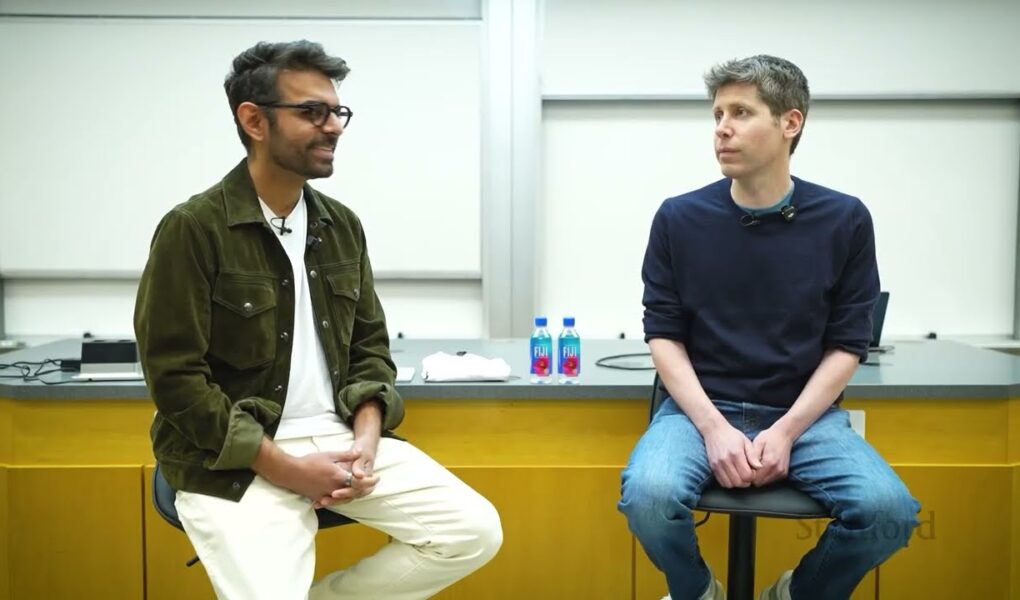
In a CS153 Frontier Systems lecture, OpenAI CEO Sam Altman returned to Stanford — where he taught the iconic CS183 How to Start a Startup in 2014 — to reflect on how radically the startup playbook has changed in the AI era, noting that a founder can now accomplish with tokens what once required a hundred-person engineering team.
Drawing on his core empirical conviction that scale reliably produces emergent properties beyond what consensus expects, Altman walked through the origin stories of both ChatGPT (a research demo that went unexpectedly viral, triggering a five-day “good emergency” that forced OpenAI to build a company and product simultaneously) and Codex (the coding bet that predated ChatGPT and finally hit its inflection point with 5.5), arguing that the current pre-training/post-training/RL pipeline will likely require a fundamental rewrite — one he expects AI itself to design. He framed intelligence as a nascent utility analogous to electricity, wrestling with how to make that concept legible to the world the way early power companies sold “light at night” rather than electricity itself, and warned that the most important unresolved fork ahead is whether this technology gets democratized broadly or concentrates in a handful of companies — a risk he put at roughly 20% probability, and one he argued is more dangerous than most safety concerns.
He closed by flagging compute shortage as an underappreciated live crisis, suggesting that as long as AI keeps improving, demand will structurally outpace supply, and urging students to consider working on inference infrastructure as one of the most underleveraged bets in the field.
Sam Altman is the co-founder and CEO of OpenAI, the AI research and deployment company behind ChatGPT. He helped launch OpenAI in 2015 with the goal of ensuring artificial general intelligence benefits all of humanity. Before OpenAI, Sam served as president of Y Combinator.
Source


owning coal factories/ nuclear plants might not be it but batteries – I think those are the future #electricity
Sam is such a scammer. The pauses and word mumbo jumbo to avoid questions. There’s so many examples…. awkward silence instead of listing them…. But for the sake of time 🤡 China got him shaking in his boots
AGI Will be man's last invention
Scam
Hindi Audio Track is superb… 😅
This is next thing waiting to be solved, Completely Solved which is no need to learn another language. Real time voice translation and most powerful translation features.
Great breakdown — the electricity analogy is one of those framings that seems obvious in hindsight but clearly wasn't at the time, and it's the right lens for where AI adoption actually sits right now. Nobody wants "infrastructure." They want the outcome the infrastructure quietly makes possible.
I feel this daily running rafikiAOS. Nobody needs to know there's a governed agentic system underneath — they just see actual songs, from actual artists, actually live on Spotify and YouTube and Apple Music. That's the light. The orchestration is the electricity, and it should stay invisible.
Sell the light. Keep building the grid. 🚀🤘🚀
Altman is in bed with the elites
AI CAN be built honestly. Gates and governance in repo are the answer.
The race should have been about trust…. Not power. Altman… Mr Altman/Uncle Sam… is a propaganda piece, preparing the way for the beast system. I have evidence
What im gonna say might sound corny, but this guy has a sorta beautiful mind, you can see how passionate he is about the dynamics of systems thinking, and he's able to bring that side out of Sam too which is also beautiful in a sense .. this is my second time coming back to this video, such a unique outlier
If Kimi K3 can achieve this level of front-end coding, surpassing fable, on constrainted compute (if i understand correctly) .. arent we placing too much importance on compute? what if theres a better answer that china has figured out .. or at least better optimizing on the compute advantages we continue to have
Couple of dip shits sucking each other off
the interviewer was extremely confusing in how the questions were asked. that seriously needs to be imporved for this level of interview
18:17 he said the quiet part out loud xD This whole industry relies on AI somehow learning how to self improve xD just one more python tool and we'll have agi xD
and did i miss something, I thought we're still using transformer models, what improvements is he hoping for xD
this interviewer is retarded, propaganda ahh vid
Any investor interested, I have a 25:17, I have the breakthrough here…
sama gives me chills and not in a good way even tho I can't quite point out the reason why
Anj is a brilliant orator, communicator and moderator. Serious gem
Damn
I mean did he really thought that it would take one year for schools to adapt to chatgpt? Based on what? I mean come on, these things takes ages to change.
siapa yang dari podcastnya pak gita??
quien es el hijo de p.. que hace el doblaje al español?
Habla sin casi mirar al entrevistador
Estoy viendo esto en septiembre 24, ya está obsoleto? Pregunta seria
"water I guess"
1. Create an AI.
2. Gain money with AI.
3. AI causes education problems.
4. 29:40 Propose a solution for the problem created with more AI usage.
5. …
6. PROFIT
The electricity point is the best part of this talk. Nobody bought 'electricity,' they bought light at night. Same with AI: people don't care about the model, they care about what it actually does for their work.
"You can make a startup with 100 great engineers for something AI credit" – that sounds just great, I guess all of engineers should just start some startups or better prove to be excellent plumbers