The Francis Crick Institute
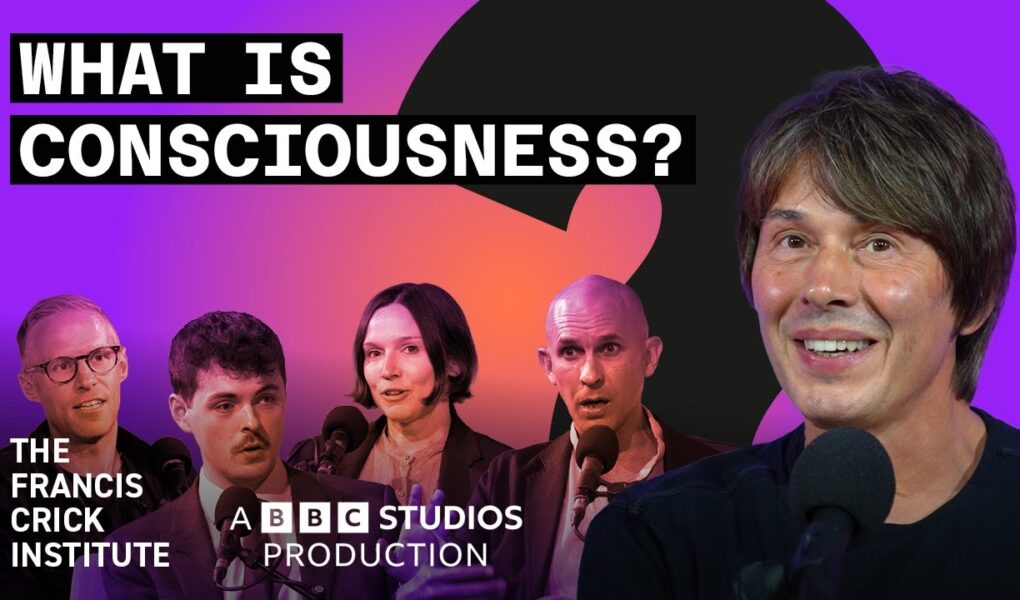
Professor Brian Cox and an expert panel explore the elusive science of consciousness – what it is, how it arises, whether it can be observed in the brain, and the most compelling theories explaining it.
In a deep, often mind-bending discussion, the panel tackles the many ways of interpreting consciousness itself, and how fields like psychophysics can be used to quantify imagination and perception.
With questions from the audience, the conversation delves into hallucinations and reality, how memory helps to build identity, and whether AI could ever be conscious too.
#Consciousness #PhilosophyOfScience #CognitiveNeuroscience
*In this episode*
00:00 What’s this episode about?
02:33 Can we define consciousness?
03:50 Can we see consciousness in the brain?
12:35 How are consciousness and memory connected?
15:38 Can you hallucinate something you haven’t experienced?
18:47 What if you didn’t have a memory?
21:17 Are animals and plants conscious?
28:16 What about other theories of consciousness?
35:30 Where do perception, hallucinations and delusions fit in?
38:42 Is consciousness linked to free will?
44:33 Can AI be conscious?
*Panellists*
• Anil Seth – Professor of Cognitive and Computational Neuroscience, University of Sussex
• Katharina Schmack – Consultant Psychiatrist and Group Leader, Neural Circuits and Immunity in Psychosis Laboratory, Francis Crick Institute
• Steve Fleming – Professor of Cognitive Neuroscience, UCL
• Alex O’Connor – Host of ‘Within Reason’ podcast
Source
Thanks for watching our videos. We keep comments open for one month after the video is published, after which we stop accepting new comments.
The views and opinions expressed in the comments to this video are solely those of the individuals and do not represent the views of The Francis Crick Institute.
Why can’t plant be conscious.
Only you yourself know yourself universe is trying all sorts of ways to explore itself.
Neti neti you can never know it nor can you know if AI is conscious or not only you yourself know I am /myself/ ego
I am very surprised they did not include any Sikh scholars on this panel as this is what Sikhi can explain
What is consciousness without language? What is thought without language?
Interesting not a single one of them mentioned wilder penfield, Eben alexander or Michael Egnor and last but not least Izthak bentov many others as well. I would rather trust those than temu scientists on that panel
I like the idea that consciousness cannot be physically seen nor can be reproduced in the lab, we cannot repeat it to produce the same results, can't even predict it through modeling… all scientific methods but consciousness is still a topic of science. 😊
I mean you could just speak to Hindus.
They'd tell you.
Can you really take a scientific reductionist approach to understand consciousness?
Anil, as you know, correlation is not causation, so as Alex mentionned, the correlates are very far from the experience of being
When my spirit come in my brain, my spirit create my consciousness. My spirit go in my brain when I am born. My brain create everything from my spirit.
Thank you for the great content!
There is Only consciousness. Enjoy the illusion/dream while it lasts.
Amazing to have Alex on a panel like this to throw some ideas in that professional academics wouldnt otherwise be challenged with. It makes it such a more rounded conversation and gets everyone out of their echo chambers
Bewustzijn is de spirit 🎉
Just as energy is the ability to move mass, consciousness is the ability to move energy
I guess consciousness is a metaphysical table inside the brain with different chairs around it there is a chair for each other the senses and everybody sit around this table talk to each other and generate instantly decisions emotions etc etc
Is consciousness PRESENT TENSE??
This is very interesting. I think apart from Alex, others are missing the point of the actual question “what is consciousness”? Others seem to be beating around the bush. I wish Roger Penrose were included in the panel !
Alex has consistently been the sole individual to address the concept of consciousness. The remaining participants have exclusively focused on observable phenomena. It is noteworthy that some of our most accomplished scientists appear to lack the phenomenological precision required to establish a clear distinction between phenomena and the perceiving subject. While the scientific method inherently necessitates the abstraction of the observer from the observed phenomena, and the meticulous recording of these observations as distinct from the observer, there appears to be a fundamental misapplication in their level of analytical scrutiny.
Their objective, in essence, is to comprehend the observer itself. Consciousness represents the act of observation, the medium within which experience originates, rather than a constructed entity. Even the brain, whether viewed through a microscope or the naked eye, constitutes merely a phenomenological construct within consciousness, specifically within the consciousness of the observer.
If consciousness is hallucination of brain's electrical or chemicial reaction who is
expereincing that subjective expereince or who is the silent spectator going through the hallucination in brain? So consciousness go beyond hallucination.
The word "consciousness" is used 68 times in the video, but this word has no meaning; it's still under research, a speculation
The comments here seem to value Alex’s philosophy and speculation over the scientists who are here to tell us, not what we wish, think, or Dunning Kruger speculate about, but about what we actually know or are in the process of uncovering.
I get it, it is sometimes more fascinating and fun to imagine and speculate, and arm chair theorize, but, to me, this is symptomatic of the Joe Rogan, ancient aliens, advanced civilization, purveyors of anti-academic, and the de-valuing of science we are witnessing.
Not saying Alex or philosophy is to blame or doesn’t have value. But there is this horrid trend of band wagonning the “scientists are close minded” because they aren’t focused on speculating outside of substantive research.
I come down on the side that says, much of the talk of consciousness is unnecessarily complex and mystified.
Once awareness evolved as in many animals, there comes a point where the feedback multiplies. You are aware of the fact that you are aware etc. since it is a process and not a thing, consciousness also evolves in stages. Even in humans we see people who are very unconscious of what’s going around them. And even the wisest of us have a huge unconscious portion which drives us.
I once heard a description that posited the conscious “I” is more like a lawyer, representing the unconscious processing. It’s actually shown to be occurring AFTER the body reacts. Our awareness of what our unconscious mind decides comes after the decision and then we take ownership of it, somewhat inaccurately.
All that to say, consciousness is the end result of feedback in the brain which then pops up to cope socially to a large degree. It “feels” and claims “I” status but it is the culmination of the 3d nervous system and the unconscious mind with many layers of feedback. It is not a thing or a spirit in a vehicle or any magical mysterious subjective entity.
There is difference between cognitive consciousness and spiritual consciousness.
Truly enjoyed this hour. AI…will all the AI be the same as each other?
I ask this because while the west is developing AI to solve problems medical, scientific, and correcting my grammar…China isn't developing their AI for just those tasks.
China is hard at work developing an AI that will yield predictive governing.
That is an entirely different approach, and may yield a very different sort of AI.
It sounds rather ominous to me.
AI cold war? Can't imagine what that would be like.
===== Dual Brain Psychology
Many organisms have two hemispheres and can be conscious. On the other hand, self-consciousness, like a mirror, is the recognition of ourselves, by reflection, from the mind in our brain's other hemisphere. Much like examining the inner workings of a radio, that cannot be understood until experiencing its result, that is, greater than the sum of its parts.
Thank you for this video, very enlightening!
You explained this so well, thank you!
I'm surprised no-one asked the question "Are you still conscious when you sleep?" When you are dreaming you feel "something" even though you are not using any of your higher functions of thought or logic. And what about semiconsciousness, when you are half-awake with thoughts just drifting? If the higher functions we associate with humans can be removed and we still have "feelings" (first definition), then it is indeed likely that it extends to animals who do not have the ability to articulate and express how they feel. This is interesting for me now because I'm reading Michael Pollan's "A world appears." Fascinating topic, thanks.
What's Nick Fuentes doing there?
Too bad about the mistaken assumption made by western theory that experience (conciousness) is matter based. That assumption is illogical at best. The west will never understand reality with that view.
Is consciousness anything more than awareness, a survival strategy?
Thank you. Conciousness is awareness that weighs attributes- values, morals, ethics and conditions and adapts, change or ignores observed in humans, plants, nature etc.
I don't know.
What is consciousness? Consciousness is a function of mind. If as the philosophy of hermeticism says, “All is mind” then everything in the Universe is consciousness. I believe consciousness has the properties of awareness and unawareness. Do particles have awareness? Are they aware of the properties they possess? They are not consciously aware of these properties but have some intrinsic awareness of them. I think of entangled particles that respond to each other no matter how far apart. It makes me think that these particles are unaware of the distance between them, They are only aware of existing in the same field.
Legendary sage Yajnavalkya (~700-800 BCE , Late Vedic era) gave one of the most sophisticated and robust model of "Consciusness" that I think people would find intriguing to read about, since I assume most viewers won't be familiar with it. Here's a gist…
1. Jagrat (The Waking State): This is our everyday, outer-directed awareness where we interact with the physical world through our five senses.
2. Svapna (The Dreaming State): This is inner-directed awareness where the physical senses sleep, but the mind remains highly active.
3. Sushupti (The Deep Sleep State): This is a state of dreamless, profound sleep where both cosmic and individual desires temporarily dissolve into stillness.
4. Turīya/Sakshi (The Fourth State): This is not a transient state, but the underlying, eternal reality that witnesses the other three states.
The Advaita-Vedanta school's non-dualistic claim rests on the foundation of this "Turiya" being the immortal witness consciousness that is inside each living being (Jeeva-Atman) and is indistinguishable from the the supreme, infinite, unchanging cosmic reality (Brahman), They are not separate; they are identical.
To anyone reading, you don't have to believe in that claim but I think I find it astonishing that the question of Consciusness has been an ongoing subject of curiousity and debate in human collective memory for around three millenia now, and the answers given by the legendary sage are just as profound as any given by modern science and philosophy.