Coleman Hughes
Think for yourself. Subscribe to The Free Press today: https://thefp.pub/3DmLpLi
The phrase “common knowledge” is usually used to mean a fact most people are aware of, like that George W. Bush was president in the early 2000s. But as cognitive psychologist Steven Pinker explains in his new book, When Everyone Knows That Everyone Knows…:Common Knowledge and the Mysteries of Money, Power, and Everyday Life, the term has a more precise meaning in game theory, philosophy, linguistics, and economics. It describes a state in which not only do I know something and you know it, but we each know that the other knows it—and know that we know that we know it—ad infinitum.
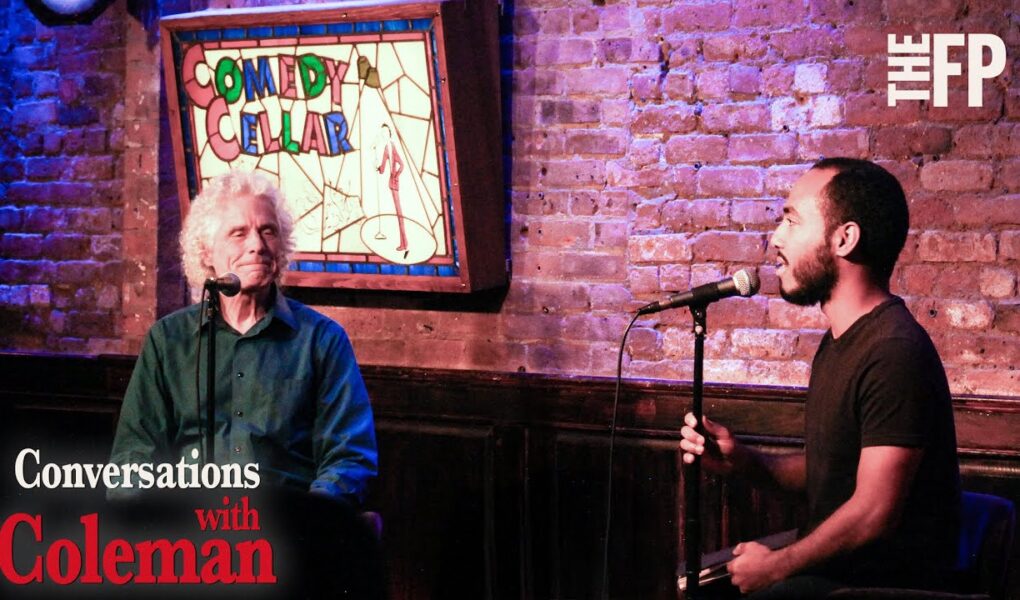
It’s a pretty headache-inducing concept, so I invited Pinker to join me live at the Comedy Cellar in New York City to break down common knowledge and explain why it matters so much in our society.
Common knowledge turns out to be one of the most powerful and underappreciated forces in our lives, one that underpins all human coordination. Pinker gives examples of how knowing what others know, and what they know that others know, is crucial for decisions ranging from the everyday, like crossing the street, to the monumental, like deciding whether to go to war. In our conversation, we explored the many fascinating facets of common knowledge. Pinker illustrated how involuntary signals, like blushing or laughter, transform private feelings into common knowledge. Common knowledge is essential for intimacy, yet it also depends on tact and selective hypocrisy to maintain relationships. Dictators try to suppress common knowledge for its power to spark collective action. From viral memes to mass movements, it shapes how we signal, bluff, conform, and dissent in public life.
Source


Steven pinker is a known friend of Jeffrey Epstein but he doesn’t like to talk about what everyone knows. Interesting!
Last year was 31.622.400 seconds ago
Interesting thing about the coordination issue with eye-contact at car-pedestrian crossings.
To avoid the pedestrian-pedestrian coordination problem (choosing which side to pass on the side-walk in awkward positioning), I have actually found that immediately breaking eye-contact fixes the problem. Very quick eye-contact to show I am aware of a possible bump, and then I break eye-contact to signal that I have chosen my path and I am committing to it. It's never failed me, and avoids the awkward dance.
When Trump blurts out something isn't that exactly the common knowledge that the young child does saying that the emperor has new clothes?
Waiting for Steven Pinker and his fans to realize that everything he says is "common knowledge."
He a Canadian who is not a Canadian, who is an American, who wasn’t born an American but a Canadian, who — 🙂 🎉
great conversation! Thank you for this. I always feel a bit ashamed about being able to watch such great conversations for free!😅I don't know where this feeling comes from. I can't thank you enough, Mr. Hughes.
Pinker doing that stupid dance after Bidens first victory because "Hitler didnt win" really lost my respect…
Pinker and Coleman …. Made my week!!!
Two of my favorite people! Thank you for this conversation gentlemen!
Two dead-heads!!
blah blah blah zzzz
Steven Pinker is one of the great minds that will direct humans to move forward. I just admire his eloquence. What a great man ❤
American power:
What about all the wars that never happened? .. “Enlightenment Now!”
It's read receipts all the way down.
About the emperor with no clothes, I guess I see it a little differently. It reads to me as, "I know, you know, I know you know, you know I know, but now it's ok to say it out loud. Someone else said it without penalty, the fear is dispelled." Is that somehow logically equivalent to what Steven is saying?
You can’t say, “Without further ado…” and then spam in an advertisement. The ad is literally “.further ado”
Thanks! That was interesting and fun. Wish I was there.
I know that all of you know that Steven Pinker was on the flight logs
Now I need to come up with a new dance for every pinker book release
We are FACING an era of "common knowledge" overkill being overridden by posting of millions of videos . public vs private