How To Academy
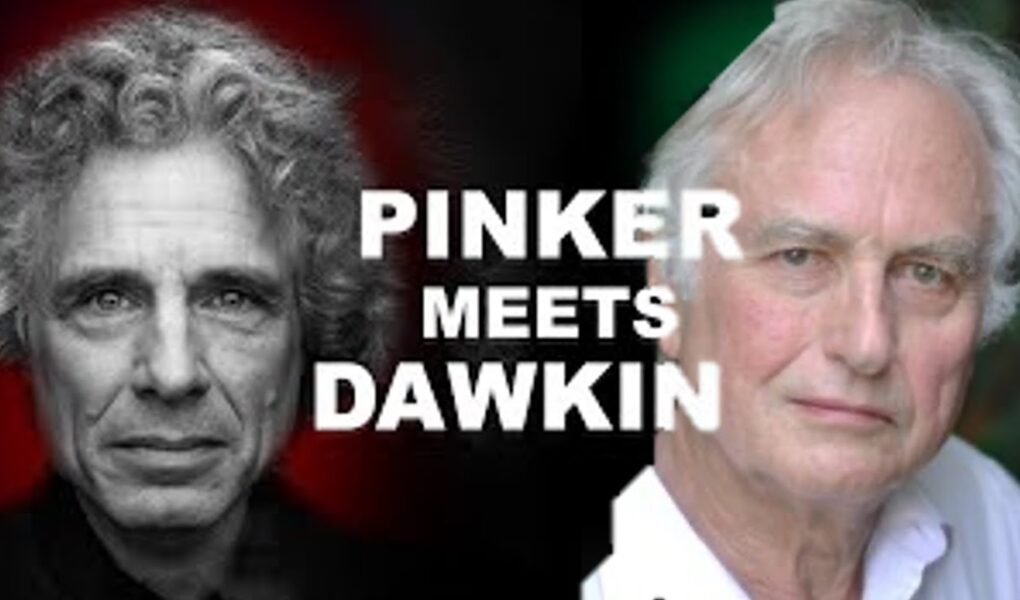
Two of the world’s most renowned scientists join us to explore the nature of reason and rationality in the age of fake news and conspiracy theories.
In the twenty-first century, humanity is reaching new heights of scientific understanding – and at the same time appears to be losing its mind. How can a species that discovered vaccines for Covid-19 in less than a year produce so much fake news, quack cures and conspiracy theorising?
From The Selfish Gene and The Blind Watchmaker to The Blank Slate and Enlightenment Now, Richard Dawkins and Steven Pinker have dedicated their lives to sharing their insights into what science and philosophy can tell us about human nature and the meaning and mystery of life.
Now they join us to debunk the cynical cliché that humans are an irrational species. Together, Richard and Steven will explore the powerful tools of reasoning that we have built up over millennia – and consider how rationality can lead to better choices in our lives and in the public sphere.
It’s an unmissable chance to hear from two of the most iconoclastic and distinguished thinkers of our time.
Steven Pinker is an experimental cognitive scientist. Currently Johnstone Professor of Psychology at Harvard, he has also taught at Stanford and MIT. He has won many prizes for his research, teaching, and his eleven books, including The Language Instinct, How the Mind Works, The Blank Slate, The Better Angels of Our Nature, and Enlightenment Now. He is a member of the National Academy of Sciences, a two-time Pulitzer Prize finalist, a Humanist of the Year, a recipient of nine honorary doctorates, one of Foreign Policy’s ‘World’s Top 100 Public Intellectuals’ and Time’s ‘100 Most Influential People in the World Today’.
Richard Dawkins is author of The Selfish Gene, voted The Royal Society’s Most Inspiring Science Book of All Time, and also the bestsellers The Blind Watchmaker, The Ancestor’s Tale, The God Delusion, and two volumes of autobiography, An Appetite for Wonder and Brief Candle in the Dark. He is a Fellow of New College, Oxford and both the Royal Society and the Royal Society of Literature. In 2013, Dawkins was voted the world’s top thinker in Prospect magazine’s poll of 10,000 readers from over 100 countries.
Source

See more of Richard here: https://youtube.com/playlist?list=PLFIigLLitqDlT00WkmkFP_y626lLrUIdb
Although Richard Dawkins is my hero, I won't watch a clip done by someone who can't get the title right. Adios.
Richard and his headset 😀
Wilson Daniel Davis Michael Johnson Edward
I have to go to work..but cant stop watching this!
When it comes to Climate Change, Scientific consensus should be taken with a grain of salt. Most scientists accepted the concept of the luminiferous ether until the Michelson-Morley experiments. Or atomic energy. or splitting the atom. with slow neutrons. Or the predominance of genes in determining IQ and other personal traits. The list goes on and on. If someone tell you that a "vote" among scientists proves that something is true, then lets get a vote on a cure for cancer!
Baes theorem is quite the topic that can lead to Injustice. There is a British woman by the name of Clark she had a baby that died from SIDS sudden infant death syndrome. The same thing happened to her second child. The British courts tried and convicted her of murder based on how improbable it was. As it turns out that there is a nine times greater chance of having 2 Sids case's then having a double murder. Her life was ruined.
This Canadian with the guard rails of a parliamentary democracy does not confront the prospect of an American idiocracy with a 9/11 truther being one of the chief adviser of the new president.
This is artificial intelligence, and this is stupid.
It's all been said before. Both have sold out empirical science to become popular…wordsmith BS . I AM A BETTER SCIENTIST THAN EITHER OF THEM.
Awareness is known by awareness alone.
Is the omission of letter “s,” from the Dawkins deliberate? Attention to detail, people.
Pinker proves his own hypothesis when he calls people either believers or deniers. Believers is a religious term not a scientific term and deniers is a political term meant to discredit anyone who’s not a believer. He also uses the term “all the scientists “ and once again lives his own sociological hypothesis. Well done Pinky.😊
And get a haircut. You look ridiculous.
Arguments for punishments reflect cruelty which is allowed by collective agreement to abuse the abused and reward the agreeable. A larger group can pick a smaller group to abuse. I control my own gun successfully, as an individual, but add abusive people deciding to be cruel as a collective, and I am not interested in helping. Attracting believers to the idea the human condition is kind and caring while reality allows rationalized punishment for individuals who punish others proves kindness and respect is personal not collective. Humanity will be cruel and cowardly, egoistic selfish and corrupted by competing with each other, or avoid.
Both very interesting intellectuals, both wrong on many things. Thanks for sharing
I'd love to hear these 2 talk after they'd both spent time with an entheogen 🌱
A study claims to have proven that "common sense" is not as common as many believe. (Or as their common sense tells them?)
FOR SURE PURE IDEAs to JUDGE THEM URGENTLY
He's taught at "Harvard," etc…. "you can't do better than that…." Give me a break.
Pinker's main thesis (and operative presupposition underlying his theory): humans on the whole live longer, are healthier, are more "free," than they were say 200 years ago. In short: Progress is real. WHY? Pinker's thesis: in the battle or free exchange of IDEAS science and logic win out; ergo TRUTH prevails in the long run. My quibble: IDEAS alone don't explain "progress" (in the above sense). MATERIAL factors appear to be more determinative. IE competition between great powers (USSR vs USA; France vs England), between alternative economic systems (Feudalism vs Capitalism; Capitalism vs Socialism; etc) is what drives change, including changes and advances in our IDEAS about the world. Competition yields efficiencies, of which scientific, social, political and ideological advances are a part. In short: the historical evidence suggest IDEAS presuppose MATERIAL changes in the lives of humans. "Progress"? The thesis is susceptible to the fatal(?) criticism that scientific advances have given us Nukes, and Nukes (biological weapons, equally) can END progress in about 2-3 hours (based on recent Pentagon estimates).
Their departure from the Religious Freedom group is hilarious. They just can't bare to say "THIS IS WRONG' "THIS IS IMMORAL" "THIS IS EVIL"
Don't want to appear to really be for religious freedom — or worse yet: To appear to realize that it is things like trans and gay and abortion that are the prelude to many becoming religious because they see just what stupid Pinker and Dawkins SEE.
Really, many in -the-middle intellectuals will have an awakening esp from Pinker's utter hypocrisy.
I am a rationalist more than an empiricist And have just discovered. I believe people are born with innate abilities that are genetically inherited. Nurture is also extremely important. The balance between nature and nurture varies tremendously in any given situation.
0:23 is this a word? (undoubtably)
As to the gun control issue – the answer would be in the individual minds & hearts – a gun is a gun but the operator is much different, being at peace would bring more stability and better judgement that in my opinion would be a combination of martial artists teaching, understanding with discipline and definite biblical strength and presence!
As to Rationalia, “If you don’t know where you’re going, you’ll probably end up someplace else!”
imagine the world if these people simply went away ❤ ah, paradise
It strikes me that Pinker doesn't really say much that convinces me of anything. I'm not sure he even knows what he thinks. Human "nature"; the word says it all. Dawkins is the most convincing, evidence speaks to everything…. One can speculate anything is truth if he doesn't require evidence. You can say Elvis is alive in Vegas, or we live forever, or there are Leprechauns. Imagination, a scientific physiological brain function, is natural to humans, but it's not enlightenment or truth. I go with evidence experiment and experience…. and skepticism.
It is rational to consider the truth as defined by irrational people to be true enough to them to be the most important truth to everyone.
Two anti trans bigots. Who cares what they think 🤷♀️
I’ve read most of Pinker’s books. A big problem with Rationality, a very good book all in all, is that two of the chapters are opened with a quote from Peter Singer, one of the most awful philosophers of all times, an illustration of how rationality pushes too far can lead to grotesque or repulsive, indeed inhuman, positions.
Just playing around with words.
Trump should watch and listen to and learn from this discussion. It might save our humanity.
I love Steven pinker so much
Respectfully, from the standpoint of philosophy, here we have two idiots speaking on things they know nothing about lol
All I hear is that disgusting smacking sound, Pinker. It’s infuriating.
Equality Hurts Nobody!
No matter whether you are numerate or not gun control is needed!