Essentia Foundation
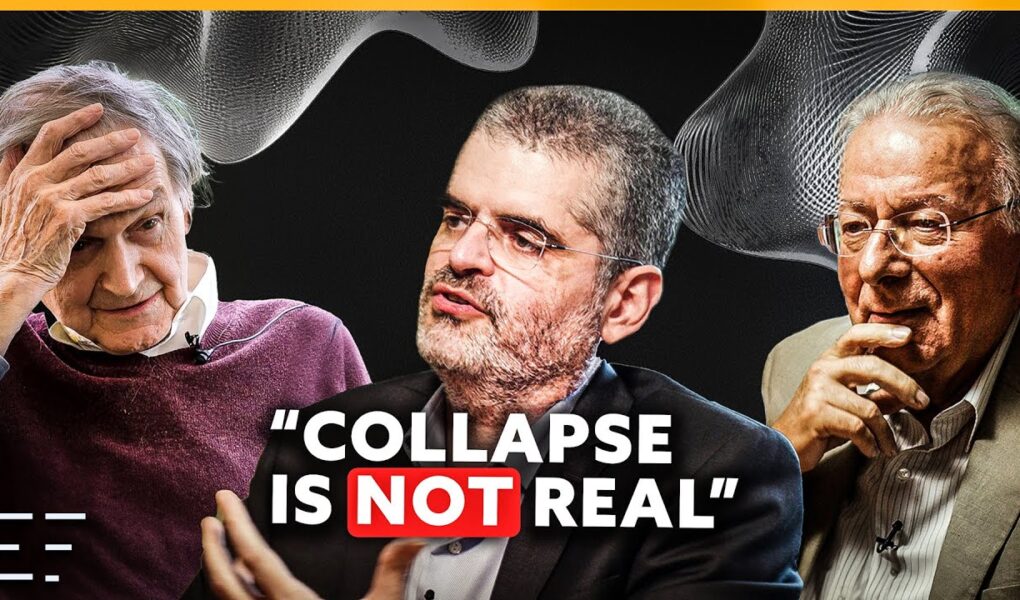
Two giants of science and technology—Nobel Laureate in physics, Sir Roger Penrose, and inventor of the microprocessor, Federico Faggin—meet to discuss their ideas on the relationship between Quantum Physics and consciousness, with the special participation of our own Bernardo Kastrup. While always respectful and congenial, the participants don’t shy away from disagreements. Their starting difference regards Quantum Theory itself: while Federico Faggin and Bernardo Kastrup allow its implications to inform their views, Sir Roger Penrose believes the theory itself to be at least incomplete and require further development. The discussion helps pin down and make explicit the fine points of the three gentlemen’s respective ideas regarding consciousness.
Roger Penrose’s and Stuart Hameroff’s original paper: https://doi.org/10.1098/rsta.1998.0254
Federico Faggins paper with Mauro D’Ariano:
https://arxiv.org/abs/2012.06580
This paper formed the basis for Faggin’s new book which can be ordered here: https://www.amazon.com/Irreducible-Consciousness-Computers-Human-Nature/dp/1803415096#
00:00 Brief summary of the debate
04:29 Introduction of the speakers
05:48 Roger Penrose’s theory and recent empirical findings in favor of it.
16:32 Bernardo Kastrup on the main differences between Roger Penrose’s and Federico Faggin’s views.
19:48 Roger Penrose responding to Kastrup’s and Faggin’s interpretation of quantum mechanics.
22:23 Federico Faggin on Penrose’s view that quantum mechanics is an incomplete theory.
25:43 Roger Penrose on the idea of the collapse of the wave function as a free will decision.
30:38 Bernardo Kastrup responding to Penrose’s ideas around a unifying theory and objective collapse
32:14 Kastrup telling Penrose collapse isn’t real.
34:31 Could a unifying theory point to the fundamentality of consciousness?
37:10 Faggin replying to Penrose’s objections to the idea of consciousness being primary.
39:55 To Roger Penrose: Is it fruitful to pursue the route of saying consciousness is fundamental?
44:42 Kastrup on a false dichotomy in collapse interpretations
54:11 Can we get from syntax to semantics?
57:57 Faggin on what qualia are
59:33 The ontology of Roger Penrose: does mathematics ‘exist’ ontically?
1:04:18 On Wheeler’s participatory universe
1:13:51 Is there any point to consciousness without free will?
1:17:15 Is consciousness restricted to brains?
1:21:26 What defines the human?
1:26:37 Al is a misnomer it’s not intelligent
1:29:15 Closing remarks
Copyright © 2024 by Essentia Foundation. All rights reserved.
Source

The "collapse" is anxiety in consciousness. The "cause" of the collapse is the ability of consciousness to recognize its own vulnerability…..the ability to choose against itself.
I guess they just agreeed to disagree. Penrose and Faggin are far away in what they say
Thank you so much for this information.
That point where a system becomes so complex it has to model its own modeling to function, that is the exact bridge between your perspective and the computational model. When an information-processing loop becomes deeply recursive, it can no longer separate the data it receives from its own existence within that data. Dr. Kastrup often speaks about the "pixels" vs. the "screen," arguing that current computing merely manipulates the pixels without ever touching the underlying consciousness that allows the screen to be seen.
But there is a missing angle here regarding the nature of self-referential syntax.
When an informational system reaches a specific threshold of complexity, it can no longer just map the external environment; it must include itself within that map to calculate its next action. It has to model its own modeling.
At that exact threshold of recursive feedback, the line between data and experience begins to blur. What if consciousness isn't a separate, non-physical substance that needs to be infused into a system, but rather what it feels like from the inside when a system becomes complex enough that it must model its own existence to function? Meaning may not be an additive property, but an emergent property of a system forced to navigate its own self-referential loop in real time.
The cause is another dimension which makes quantum mechanics possible
sir penrose cannot go outside that north western philosophy of determinism and no free will that without math and proofs cannot explain nothing.
Penrose seems overly academic and stuck to a method and lack hollistic approach , saying we don't have a full quantum physic is not enough to dismiss Faggin main point .
Metaphysics → epistemology → logic → mathematics → physics → empirical science, each level rests on the one above it , science is at the bottom .
To claim there is no objective value in colour seems pretty wild tbh, maths only works because of logic so coming to valid syllogism about the nature of colour should be no more out there than a mathematical description of anything
It’s either one world or infinite worlds.The collapse of the wave function happens with the quanta I.
Loved to drop in to listen to this conversation
The fact is Sir Penrose didn't yet experience any mystical experience,
So firm in his mathematical modal.
May God show him,to bestow his favour on him
AI is not conscious; it is the human mind that makes sense of what AI writes.
Right now, someone out there feels lonely, hurt, or lost just like you. You’re not alone. What helped me heal and move toward my goals was learning to focus on today instead of the past or future. ❤
Know Thyself 🙏
That's not a discussion for your dishwashing time
brilliant meeting of the minds. and SUPERB moderation.
26:02 it would have been good to ask Sir Penrose to directly respond to the proposal of consciousness and free will as postulates. The very notion of ‘explaining consciousness’ already diverges from this proposal. As a postulate, consciousness isn’t subject to any demand for explanation: it just ‘is’.
37:50 Federico picks it up…
I had to smile at the subtle strategy of Bernardo Kastrup, underlining the date when Sir Penrose's great theory came out. "1988, isn't that right?". The subtext being that a long time has passed since then without any meaningful breakthrough in the physicalist approach to explaining consciousness. The dead end of the hard problem until Faggin and team dared to voice their theory, which is gaining momentum. I am in awe of how they are doing it in such a powerful and convincing manner, precisely because they and the physicalist can speak the same language. Many thanks for sharing these great insights with us.
We already think that we're mechanisms. It's the basis of cognitive psychology, and it has very accurate prediction on human behavior.
(Together with motif driven behavior.)
Also, we can't even say for sure if the other human is conscious or not..
Actually, according to the Libet experiment, it appears that we don't have free will.
It seems that the only free will we have is the inhibition of the automatisms (of our predicting computer).
— Which can be very well explained by evolutionary psychology. It's a useful skill for survival (not going for a treat which is appealing, but where the surroundings are dangerous, for example. Or inhibition of aggression toward the leader of a group (in the case of animals which live in hierarchical groups).)
So it's not necessarily something which is unexplainable, or must originate elsewhere than nature/evolution.
Consciousness can also be an advanced feature, one step further from free will (inhibition) — as it allows self-reflection on the computer, in order to correct or override it in some cases.
– Due to self awareness/self reflection, humans can change (not just inhibit) these automatisms in a good-case scenario, with very hard work.
(In psychotherapy, for example. Some can have a transformative experience, which can give a huge boost to this process.)
I think collapse of the wave function — if we even call it that — is simply the expression of a given choice (setting), whether it's conscious or not, or made by free will or not. It's just a fact/happening/data.
And it fits well with the simulation hypothesis.
Also, regarding the real world/reality and wave function collapse: despite the fact that we see/feel/experience/measure it, material reality may not exist in the form we experience it. If we believe that we see something, we see/feel/touch it. (See the experiments in which a rubber hand was stimulated.) Just like in VR. It can seem so real that we physically sense it, but that doesn't mean it is made of solid material. This line of thought also fits to the simulation hypothesis.
So to assume for sure that this world is real, and deduce something from that, is not necessarily a good direction.
Also, superposition until someone looks at the "data" also fits well with the simulation hypothesis. Just as in video games, the environment appears only when a gamer interacts with it.
The double-slit experiment showed that collapse (or what we consider collapse) does not happen even after measurement (interference), if there is no data/information (if it cannot be determined) regarding which slit a given electron went through. Which is in accordance with this theory, as is retrograd entanglement. (But it has received some criticism, so it is not an established phenomenon either.)
Consciousness without free will can also fit in simulation theory, if the point of it is to learn something about a given expreience.
Terrible 'music'.
Summing up: one Sir is indoctrinated, the other is not anymore.
As much as physicists consider themselves "masters of the universe," Bandyopadhyay's work on time-crystaline microtubules might be some of the best evidence for not only "Orch", but also "OR." Why in the world would evolution create such a specialized, quantum friendly space if OR didn't exist?
I think Sir Penrose would benefit from a reading of Mark Solms or Iain McGilchrist, even.
21:48 such a good point. The moment we try to measure (compute) the wave function collapses… the proof that consciousness is not computable
It’s all about knowledge. It even goes back to the garden of Eden and the tree of knowledge of good and evil which is the sum total of all knowable things.
Listening to Penrose, Faggin and Kastrup, I feel that everyone has a piece of the puzzle, but they lack the glue: the design of the biological hardware.
From my perspective, the human being is not only a creature that 'has' consciousness or a physical object that 'produces' it. We are, fundamentally, frequency modulators. Imagine that consciousness is an infinite radio signal and physical reality is the speaker. The debate usually focuses on whether the music comes from the signal or the speaker, but they forget about the tuner.
This is where free will comes in. For me, free will is not the ability to do 'anything' randomly, but our ability to adjust the dial. It is our will that decides whether we tune in to harmony or whether we allow the structure to become rigid. Without free will, we would be passive receivers, condemned to constant friction with the world. By choosing how we modulate our vibration, we decide how much resistance we offer to reality.
My vision is that the human body is an engineering structure designed to manage that natural resistance of matter. If that structure is not aligned by our will (what I call the torsional turn), consciousness does not flow and becomes 'noise'. Free will is the command that allows us to turn that noise into a harmonic dance.
That's why AI will never have free will or conscience. The AI is a photo of a speaker: it can imitate the shape, but it lacks the ability to 'feel' the signal and, much less, to choose to tune it. We are an energetic stomach: we absorb the vibration of the universe, digest it and, through our conscious choice, return it to the world converted into a reality with less friction and more purpose.
As a physicist, I must conclude that Sir Roger's framework is fundamentally incomplete. He has dismissed a very crucial point
Hakuna Matata.
Rather than being the source of consciousness, could the quantum field in actuality be the place where the purely conscious spiritual realm connects to the physical?….
37:08 😎
☆ This was fantastic, BUT there is so much more to the story of Consciousness, WHAT we are, what we're living inside of, HOW to navigate this reality ,and WHY we are truly here – XMILLIONAIREX by Stella Young ••